Notable Works
- Ozymandias
- Ode to the West Wind
- To a Skylark
- Prometheus Unbound
- Adonais
- The Mask of Anarchy
Percy Bysshe Shelley was the most radical and idealistic of the major Romantic poets, combining technical brilliance with revolutionary political vision. His lyric poems soar with visionary intensity, while his longer works articulate a philosophy of liberation, love, and the transformative power of imagination.
Privileged Beginnings and Early Rebellion
Born in 1792 into an aristocratic family at Field Place, Sussex, Shelley was heir to a baronetcy and considerable wealth. He attended Eton and Oxford, where his brilliance and eccentricity were already evident. But Shelley rebelled violently against the privilege and conservatism of his class.
At Oxford in 1811, he published a pamphlet titled “The Necessity of Atheism,” which resulted in his expulsion. His father, outraged, cut off support unless Shelley recanted. He refused. This pattern—principled defiance leading to personal catastrophe—would characterize his life.
Early Marriages and Radical Politics
At nineteen, Shelley eloped with sixteen-year-old Harriet Westbrook, supposedly to rescue her from boarding school tyranny. They married despite Shelley’s belief that marriage was a tyrannical institution. The marriage was troubled from the start.
During these years, Shelley immersed himself in radical politics and philosophy. He read William Godwin’s anarchist philosophy, which argued that reason and benevolence could create a perfect society without government or religion. Shelley wrote political pamphlets, including support for Irish independence, and lived according to his principles: vegetarianism, free love, atheism, and political radicalism.
Mary Godwin and Social Ostracism
In 1814, Shelley met Mary Godwin, daughter of the philosopher William Godwin and the feminist Mary Wollstonecraft (who died shortly after Mary’s birth). Despite both being married—Shelley to Harriet, and Mary’s father opposing the relationship—they fell in love and eloped to the Continent, taking Mary’s stepsister Claire Clairmont with them.
This scandal destroyed Shelley’s remaining social connections. When Harriet drowned in 1816 (likely suicide), Shelley married Mary, but he was denied custody of his children by Harriet on grounds of his atheism and immorality. This judicial cruelty devastated him and confirmed his view of institutional authority as tyrannical.
The Summer of 1816
The summer of 1816, spent near Lake Geneva with Lord Byron, was extraordinarily creative. Mary began writing “Frankenstein,” Byron wrote “The Prisoner of Chillon,” and Shelley composed “Hymn to Intellectual Beauty” and “Mont Blanc.” The friendship between Shelley and Byron—the idealist and the cynic—was one of the great literary relationships.
Italian Exile
In 1818, the Shelleys moved to Italy, where they would remain. Italy’s warmth, art, and distance from English judgment suited Shelley, though personal tragedies continued—three of his four children died between 1818 and 1819, devastating both Percy and Mary.
Despite this suffering, Shelley’s Italian years were his most productive. He wrote:
- “Prometheus Unbound” (1820): A lyrical drama reimagining Aeschylus’s myth, with Prometheus representing humanity freed from tyranny through love and imagination
- “The Mask of Anarchy” (1819): A fierce political poem responding to the Peterloo Massacre, calling for nonviolent resistance
- “Ode to the West Wind” (1820): Invoking natural power as a metaphor for revolutionary change
- “To a Skylark” (1820): Celebrating the bird’s joy and the poet’s aspiration to pure expression
- “Adonais” (1821): An elegy for John Keats, defending poetry against its detractors
Poetic Innovations
Shelley’s poetry is characterized by:
- Visionary intensity: Images of light, wind, water, and transformation
- Lyric perfection: Intricate stanza forms and musical language
- Political passion: Advocacy for liberty, equality, and revolution
- Philosophical depth: Engagement with Platonic idealism and radical thought
- Natural imagery: Nature as symbol of spiritual and political transformation
His technical virtuosity was extraordinary. “Ode to the West Wind” uses terza rima (Dante’s meter) in a complex pattern leading to a Shakespearean sonnet conclusion. “The Triumph of Life,” unfinished at his death, employs terza rima to create a vision of stunning difficulty and power.
“Ozymandias”
Among Shelley’s most famous poems is “Ozymandias,” a sonnet about a ruined statue in the desert. The tyrant’s boast—“Look on my Works, ye Mighty, and despair!”—becomes ironic when the works have crumbled to nothing. The poem encapsulates Shelley’s political vision: all tyranny is temporary, and human pride is nothing before time and nature.
“A Defence of Poetry”
Shelley’s essay “A Defence of Poetry” (1821, published posthumously) is one of the great statements of Romantic poetics. He argues that poets are “the unacknowledged legislators of the world,” that imagination and love—not reason alone—can transform society, and that poetry cultivates the moral imagination necessary for justice.
This isn’t mere aesthetic theory but political philosophy: poetry creates empathy, allowing us to imagine others’ experiences and thus to act with compassion. Shelley believed poetry could help create a more just world.
The Pisan Circle
In Pisa, Shelley gathered a circle including Byron, Edward and Jane Williams, and Edward Trelawny. This period saw important friendships and creative work. Shelley wrote some of his finest lyrics, including poems to Jane Williams that show a tenderness and simplicity different from his visionary mode.
Death at Sea
On July 8, 1822, Shelley was sailing back to Lerici with Edward Williams when their boat, the Don Juan, sank in a sudden storm. Shelley drowned at age twenty-nine. When his body washed ashore days later, he was identified by the books in his pockets—a volume of Keats in one, Sophocles in the other.
His friends cremated his body on the beach. Byron and Leigh Hunt watched as Trelawny performed the ceremony. Shelley’s heart, which wouldn’t burn, was snatched from the flames and eventually given to Mary, who kept it until her death.
Posthumous Reputation
Victorian England embraced Shelley’s lyricism while suppressing his radicalism, creating a sanitized version of the poet. By the late nineteenth century, he was beloved for poems like “To a Skylark” and “The Cloud,” while his political works were neglected.
Twentieth-century scholarship recovered the radical Shelley, recognizing how deeply his politics and poetry were intertwined. His atheism, vegetarianism, advocacy of free love, and revolutionary politics—scandalous in his time—now seem prescient.
Legacy and Influence
Shelley influenced later poets including Browning, Yeats, and the Modernists. His combination of technical mastery and visionary idealism, his belief in poetry’s power to change consciousness and thus society, and his unflinching commitment to his principles make him a central figure in Romanticism.
His personal life—the elopements, the tragedies, the exile, the early death—has sometimes overshadowed his achievement. But his greatest poems—“Prometheus Unbound,” “Ode to the West Wind,” “Adonais,” “The Triumph of Life”—rank among the supreme achievements of English poetry.
The Idealist’s Legacy
Shelley lived and wrote as if a better world were possible, as if imagination and love could overcome tyranny and hatred. His famous conclusion to “Prometheus Unbound” envisions humanity liberated:
“To suffer woes which Hope thinks infinite; To forgive wrongs darker than death or night; To defy Power, which seems omnipotent; To love, and bear; to hope till Hope creates From its own wreck the thing it contemplates”
This vision—of hope creating what it imagines—defines Shelley’s poetry and his life. He believed that by imagining a just world, poetry helps create it. That revolutionary faith in imagination’s power remains his enduring gift to poetry and to politics.
Influenced By
- John Milton
- William Godwin
- William Wordsworth
- Plato
Influenced
Poems by Percy Bysshe Shelley (1)
Browse with filters →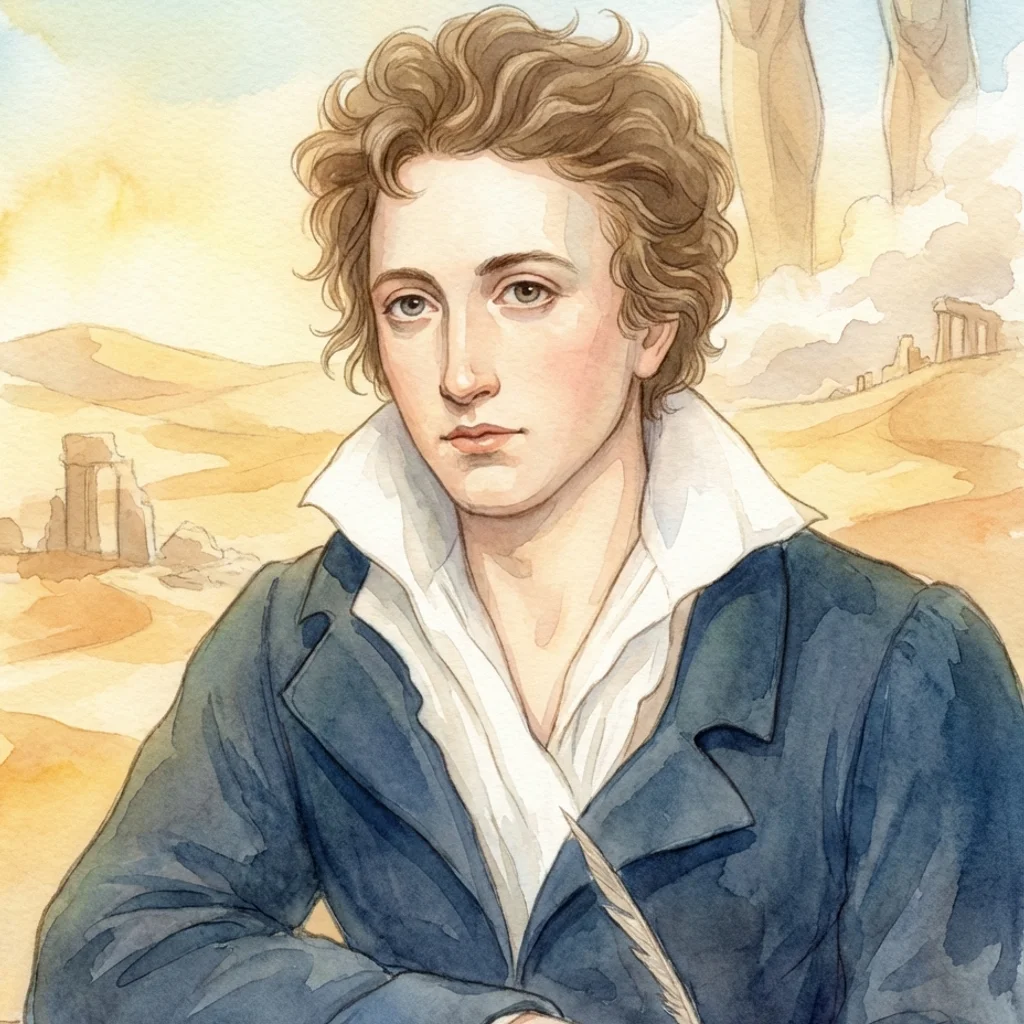
1817