Notable Works
- Ode to a Nightingale
- Ode on a Grecian Urn
- To Autumn
- The Eve of St. Agnes
- La Belle Dame sans Merci
- Endymion
John Keats, who died at twenty-five, created some of the most sensuously beautiful and intellectually complex poems in the English language. His great odes—“Ode to a Nightingale,” “Ode on a Grecian Urn,” “To Autumn”—represent the pinnacle of Romantic achievement, exploring the relationships between beauty, truth, mortality, and the imagination with unmatched lyrical power.
Early Life and Family Tragedy
Born in London in 1795, Keats came from a lower-middle-class family. His father managed a livery stable, and the family seemed reasonably prosperous. But tragedy struck early and repeatedly. His father died from a riding accident when Keats was eight; his mother died of tuberculosis when he was fourteen. Keats and his siblings were left in the care of guardians who controlled their inheritance.
At school in Enfield, Keats distinguished himself academically, developing a love of classical literature and beginning to read voraciously. His schoolmaster’s son, Charles Cowden Clarke, became an important early mentor, introducing him to Spenser, Shakespeare, and contemporary poetry.
Medical Training and Literary Ambitions
Following his mother’s death, Keats was apprenticed to a surgeon-apothecary. In 1815, he entered Guy’s Hospital in London to become a licensed surgeon. He qualified remarkably quickly, but by 1816, he had decided to abandon medicine for poetry—a financially precarious choice that his guardian opposed.
Keats later wrote that he was certain of nothing but “the holiness of the Heart’s affections and the truth of Imagination.” This commitment to poetry as a sacred vocation, despite his lack of financial security or family support, defined his brief career.
Literary Circles and First Publications
Through his friend Clarke, Keats met Leigh Hunt, editor, poet, and political radical. Hunt championed Keats, publishing his work and introducing him to the literary circles that included Percy Shelley, William Hazlitt, Benjamin Robert Haydon, and others. This circle valued imagination, beauty, and political liberalism.
Keats’s first collection, “Poems” (1817), received little attention. His second major work, the long mythological poem “Endymion” (1818), was savagely attacked by critics, partly for aesthetic reasons but also because Keats was associated with Hunt’s radical “Cockney School.” The reviews stung Keats deeply, though the later myth that they killed him is exaggerated.
The Great Year: 1818-1819
Between late 1818 and late 1819, Keats wrote the poems that secured his immortality. This extraordinary period of creativity produced:
- The Great Odes: “Ode to a Nightingale,” “Ode on a Grecian Urn,” “Ode to Psyche,” “Ode on Melancholy,” “To Autumn”
- Narrative poems: “The Eve of St. Agnes,” “Lamia,” “La Belle Dame sans Merci”
- Unfinished epics: “Hyperion” and its revision “The Fall of Hyperion”
These works show Keats developing his central preoccupations:
- Beauty and its transience: The tension between eternal art and mortal life
- Imagination and reality: The power and limitations of visionary experience
- Pleasure and pain: The inseparability of joy and sorrow
- Permanence and change: The desire for immortality versus the inevitability of death
The Odes
Keats’s odes represent his supreme achievement. Written in ten-line stanzas (except “Nightingale,” which uses eight lines), they combine intense sensory imagery with profound philosophical meditation.
“Ode to a Nightingale” explores the desire to escape mortality through the immortal song of the bird, only to return to “the weariness, the fever, and the fret” of human life. The poem’s final question—“Was it a vision, or a waking dream?”—leaves unresolved whether imagination offers genuine transcendence or mere illusion.
“Ode on a Grecian Urn” addresses an ancient urn whose frozen scenes of lovers and musicians seem to promise immortality through art. The poem concludes with the famous (and much-debated) statement: “Beauty is truth, truth beauty,—that is all / Ye know on earth, and all ye need to know.”
“To Autumn” is perhaps the most perfect nature poem in English, celebrating the season’s abundance while acknowledging its position on the edge of winter and death. Unlike the other odes, it achieves acceptance rather than longing, finding beauty in ripeness and decay.
Poetic Theory: Negative Capability
In his letters—themselves among the finest prose of the period—Keats articulated important aesthetic ideas. Most famous is “Negative Capability,” which he defined as “when man is capable of being in uncertainties, Mysteries, doubts, without any irritable reaching after fact & reason.”
This concept values receptivity over assertion, mystery over certainty, and describes the kind of empathetic imagination Shakespeare possessed. Keats argued that great poetry emerges not from imposing the poet’s personality but from surrendering to experience and allowing multiple perspectives.
Love and Fanny Brawne
In 1818, Keats met Fanny Brawne, his neighbor, and fell deeply in love. They became engaged, but Keats’s poverty and deteriorating health made marriage impossible. His passionate, sometimes desperate letters to Fanny reveal his emotional intensity and his anguish at their separation.
Illness and Death
Tuberculosis (the disease that killed his mother and brother Tom) began affecting Keats in early 1820. He coughed up blood and recognized, with his medical training, that he was likely doomed. His final volume, “Lamia, Isabella, The Eve of St. Agnes, and Other Poems” (1820), appeared to favorable reviews, but Keats was too ill to enjoy his growing recognition.
In September 1820, on his doctor’s advice, Keats sailed to Italy, hoping the warmer climate would help. He settled in Rome with his friend, the painter Joseph Severn. His condition worsened steadily. He died on February 23, 1821, at age twenty-five, requesting that his tombstone read: “Here lies One Whose Name was writ in Water”—expressing his fear that he would be forgotten.
Posthumous Reputation
Keats’s friends, particularly Shelley (who wrote “Adonais” as an elegy for Keats) and Hunt, worked to establish his reputation. Victorian readers embraced his sensuous beauty, though often missing his intellectual complexity. The Pre-Raphaelites particularly admired him.
By the late nineteenth century, Keats was recognized as one of the greatest English poets. Twentieth-century critics appreciated his philosophical depth, his exploration of consciousness, and his technical mastery.
Legacy and Influence
Despite his brief career, Keats’s influence has been enormous:
- Sensory richness: His capacity to evoke sensation through language remains unmatched
- Philosophical odes: He perfected the meditative ode exploring abstract ideas through concrete imagery
- Romantic subjectivity: His exploration of consciousness influenced modernist poetry
- Aesthetic theory: Negative Capability remains a central concept in poetics
Keats demonstrated that poetry could combine luxurious beauty with intellectual rigor, that it could question its own assumptions while creating sublime effects. His letters show a brilliant critical mind developing aesthetic theories while his poems enact those theories with incomparable artistry.
He wrote to his brother: “I think I shall be among the English Poets after my death.” This has proven one of the great understatements in literary history—Keats is not merely among the English poets but among the very greatest, his brief life producing an enduring body of work that continues to move, challenge, and inspire readers.
Influenced By
- William Shakespeare
- John Milton
- Edmund Spenser
- William Wordsworth
Influenced
Poems by John Keats (1)
Browse with filters →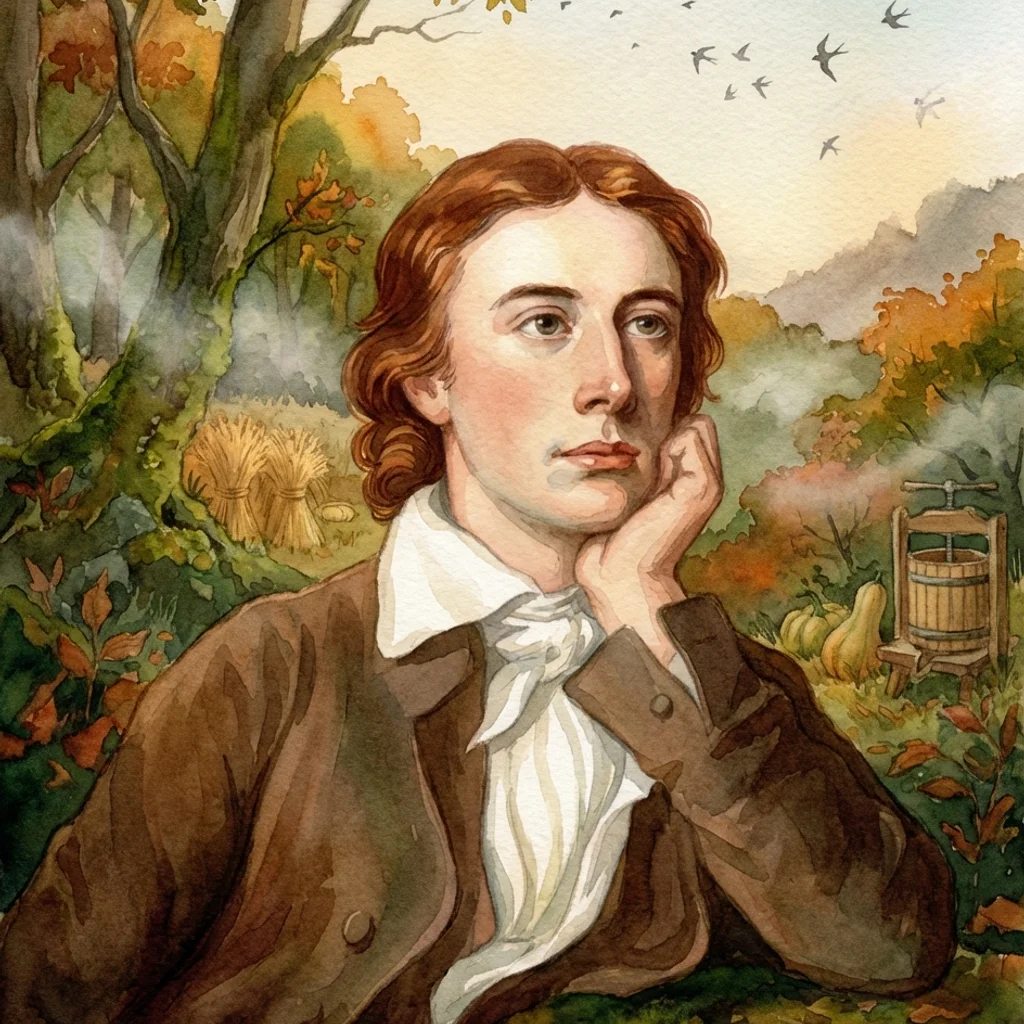
1819