Notable Works
- The Raven
- Annabel Lee
- The Bells
- Ulalume
- To Helen
- Lenore
Edgar Allan Poe was an American writer who created some of the most haunting and influential works in American literature. While best known today for his short stories that pioneered detective fiction and psychological horror, Poe was also a major poet whose work explored themes of death, lost love, and beauty with unmatched musical virtuosity. His influence extends far beyond literature into popular culture, where his dark romanticism and gothic sensibility continue to resonate.
Early Life and Loss
Born in Boston in 1809 to itinerant actors, Poe experienced abandonment and loss from infancy. His father disappeared when he was a year old; his mother died of tuberculosis when he was three. He was taken in—though never formally adopted—by John and Frances Allan, a wealthy Richmond, Virginia, couple. This ambiguous status as neither child nor servant would haunt Poe throughout his life.
Frances Allan loved Poe and encouraged his literary interests, but John Allan was stern and disapproving, particularly after Poe began incurring gambling debts at the University of Virginia. The relationship deteriorated completely when Allan refused to pay Poe’s debts, forcing him to leave university after only one year. This pattern of promise followed by catastrophic disappointment would characterize Poe’s entire life.
Military and Literary Beginnings
Desperate and penniless, Poe enlisted in the Army under an assumed name in 1827. That same year, he published his first collection, Tamerlane and Other Poems, anonymously and to no notice. He later attended West Point Military Academy but deliberately got himself expelled, apparently in a final break with John Allan.
Between 1827 and 1831, Poe published three poetry collections that established his major themes and style. These early poems—including “To Helen,” with its famous lines “Helen, thy beauty is to me / Like those Nicean barks of yore”—demonstrate Poe’s gift for musical language and his idealization of female beauty.
Marriage and Literary Career
In 1835, Poe married his thirteen-year-old cousin Virginia Clemm, a marriage that has troubled biographers. While deeply unconventional, by all accounts they loved each other genuinely. Virginia’s deteriorating health from tuberculosis—the disease that had killed Poe’s mother and foster mother—would haunt the last decade of her life and inspire some of Poe’s most famous poems.
Poe worked as an editor for various magazines, including the Southern Literary Messenger and Graham’s Magazine, where his savage critical reviews earned him many enemies. He was a brilliant editor and critic who helped raise literary standards in American periodicals, but his drinking, poverty, and quarrelsome nature kept him from stable employment.
“The Raven”
Published in January 1845, “The Raven” made Poe famous overnight. The poem tells of a grieving man visited by a talking raven whose only word, “Nevermore,” drives him to despair. The poem’s hypnotic rhythm, internal rhymes, and repetitive structure create an incantatory effect: “Once upon a midnight dreary, while I pondered, weak and weary, / Over many a quaint and curious volume of forgotten lore.”
The raven becomes the speaker’s torturer, confirming his worst fears about death’s finality and lost love’s irretrievability. The poem’s psychological intensity—the speaker half knows he’s tormenting himself—combines with its formal brilliance to create Poe’s masterpiece. It became the most popular poem in America and remains among the most recognized poems in English.
Poe’s essay “The Philosophy of Composition” (1846) purports to explain “The Raven’s” deliberate construction, though scholars debate how much is genuine analysis versus self-mythologizing. The essay’s assertion that he chose the refrain first, then built the poem around it, has been influential on poets interested in craft.
Poetic Theory
Poe developed a sophisticated poetic theory centered on “the rhythmical creation of beauty.” In “The Poetic Principle,” he argued that poetry’s sole purpose is to create beauty and elevate the soul, not to teach moral lessons or convey truth. This aesthetic position, radical in moralistic nineteenth-century America, anticipated the art-for-art’s-sake movement.
He believed the ideal poem should be brief—readable in one sitting—to maintain a unified emotional effect. Long poems, he argued, were necessarily interspersed with prose passages and thus not truly poetry. This theory, while limited, explains his own practice: most of his poems are short to medium length.
Poe emphasized music over meaning, believing poetry should primarily appeal through sound. This emphasis on euphony over intellectual content has made him controversial among critics who value complexity and ideas, but his position has influenced generations of poets interested in poetry’s sonic dimensions.
Later Poems
After Virginia’s death in 1847, Poe wrote several poems addressing lost love. “Ulalume” (1847) narrates a nighttime journey culminating in the unwitting arrival at a lover’s tomb. The poem’s dense allusions and invented words create an atmosphere of dreamlike grief.
“Annabel Lee,” published shortly after Poe’s death, tells of a love so strong that angels grew jealous and killed the speaker’s beloved. The poem’s simple ballad meter and childlike language create an eerie contrast with its obsessive necrophilic undertones: “And so, all the night-tide, I lie down by the side / Of my darling—my darling—my life and my bride.” The poem has been read biographically as Poe’s elegy for Virginia.
“The Bells” demonstrates Poe’s mastery of onomatopoeia, with different sections evoking sleigh bells, wedding bells, alarm bells, and funeral bells through sound alone. The poem moves from joy to terror to death, its language increasingly harsh and discordant.
Prose and Detective Fiction
While poetry was Poe’s first love, he made his living primarily through prose. His short stories invented or perfected several genres: the detective story (“The Murders in the Rue Morgue”), psychological horror (“The Tell-Tale Heart,” “The Fall of the House of Usher”), and science fiction (“The Narrative of Arthur Gordon Pym”). These works share with his poetry a fascination with the macabre, the irrational, and the power of obsession.
His critical writing was equally influential. He championed high standards and attacked what he saw as mediocrity, particularly the Boston literary establishment. His rivalry with Henry Wadsworth Longfellow, whom he accused of plagiarism, shows both his critical acumen and his paranoid tendencies.
Mysterious Death
Poe died in Baltimore in October 1849 under mysterious circumstances. He had been found delirious in the street, wearing clothes not his own, and died four days later. The cause of death remains disputed—theories include alcoholism, rabies, cholera, epilepsy, and even murder. His death, like his life, has become the subject of legend and speculation.
His funeral was attended by fewer than ten people. The minister who presided later remarked that he said nothing about Poe’s literary work because he knew nothing of it—a sad epitaph for America’s greatest poet of his era.
Reputation and Influence
Poe’s literary reputation fluctuated wildly after his death. In America, he was often dismissed as morbid and unwholesome. However, in France, Baudelaire’s translations made Poe a major influence on Symbolism and Decadence. Through this French connection, Poe influenced modernist poetry worldwide.
American appreciation grew in the twentieth century. His influence on popular culture has been enormous: countless films, television shows, and works of fiction reference his work. His pioneering of detective fiction, horror, and science fiction established templates still in use today.
Legacy
Poe occupies a unique position in American letters. He was among the first American writers to try to live entirely by writing, and his struggles with poverty and critical neglect dramatize the difficulty of that enterprise. His insistence on craft and beauty over moral instruction helped establish American literature’s artistic legitimacy.
His poetry demonstrates that emotional intensity and musical language can create powerful effects even when intellectual content is minimal. His dark romanticism—beautiful terror, love stronger than death, madness as insight—continues to captivate readers who recognize in his obsessions something universal about loss, fear, and the unconscious mind.
Whether read as psychological studies, musical experiments, or gothic entertainment, Poe’s best poems retain their power to haunt and enchant. His distinctive voice—melancholy, musical, macabre—remains immediately recognizable nearly two centuries after his tragic death.
Influenced By
Poems by Edgar Allan Poe (1)
Browse with filters →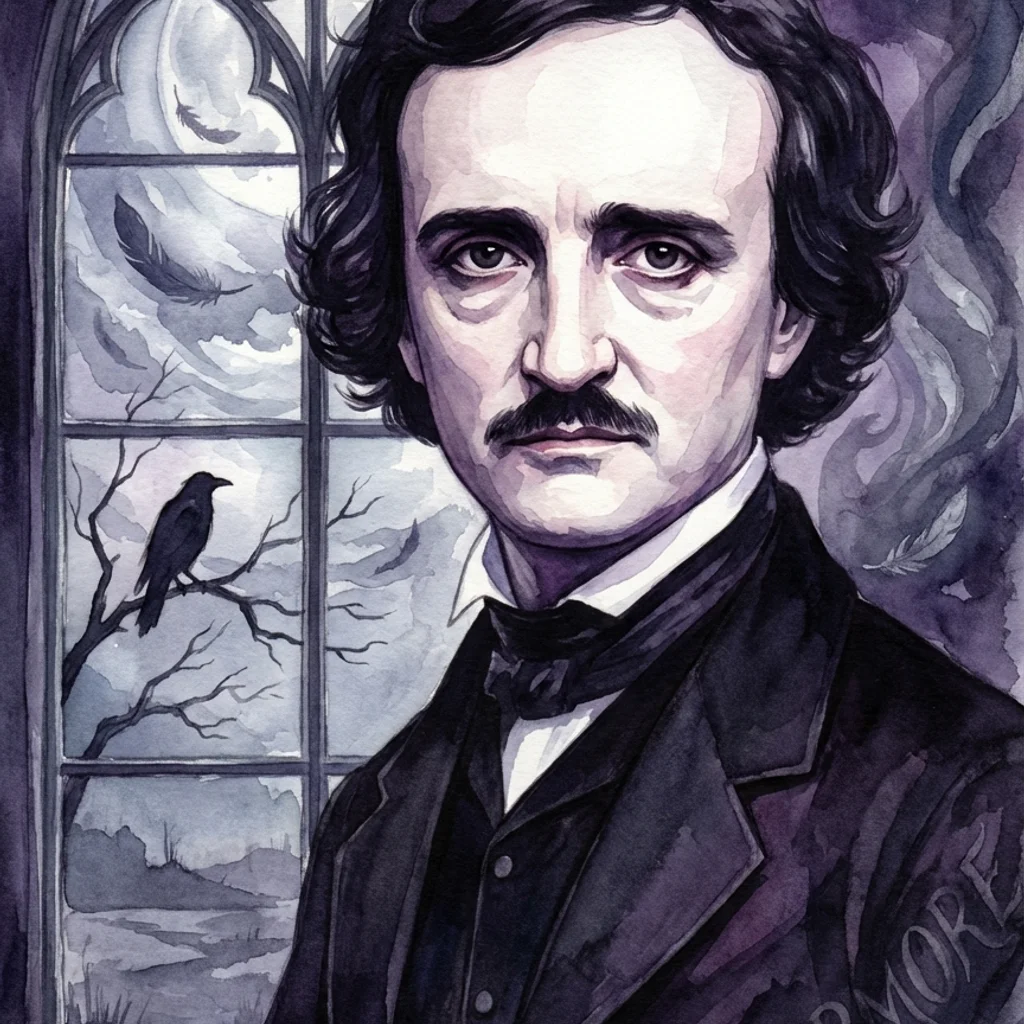
1845