Notable Works
- Funeral Blues (Stop all the clocks)
- The Age of Anxiety
- September 1, 1939
- Musée des Beaux Arts
- In Memory of W.B. Yeats
- The Shield of Achilles
Wystan Hugh Auden was one of the most influential poets of the twentieth century, known for his technical virtuosity, intellectual range, and ability to write memorably about the political and psychological anxieties of his age. Over a career spanning five decades, he moved from left-wing political engagement in the 1930s to a more complex Christian humanism, all while maintaining an extraordinary command of traditional forms and contemporary idiom.
Early Life and Education
Born in York in 1907, Auden grew up in Birmingham, where his father was a physician and his mother a nurse. His early interests were scientific—he studied biology and geology—and this scientific training would influence his poetry’s precise observations and diagnostic approach to human behavior.
At Oxford University in the 1920s, Auden became the central figure of a group of young poets including Stephen Spender, C. Day-Lewis, and Louis MacNeice. These writers, later known as the “Auden Generation,” shared leftist political sympathies and a determination to write poetry that engaged with contemporary social issues rather than retreating into purely aesthetic concerns.
The 1930s: Political Engagement
The 1930s established Auden’s reputation as the voice of his generation. His early poetry combined modernist techniques with topical concerns, addressing unemployment, class struggle, and the rise of fascism. Poems like “Spain” (1937), written after he briefly drove an ambulance for the Republican forces during the Spanish Civil War, exemplified the era’s conviction that writers had a duty to take political stands.
“September 1, 1939,” written as World War II began, remains one of his most famous poems despite his later ambivalence about it. The poem’s speaker sits “in one of the dives / On Fifty-second Street / Uncertain and afraid” as the world descends into war, analyzing the psychological and historical forces that have led to catastrophe. Lines like “We must love one another or die” became iconic, though Auden later tried to suppress the poem, feeling it was dishonest.
Technical Mastery
Auden was perhaps the most technically accomplished poet in English since the seventeenth century. He could write brilliantly in virtually any form: sonnets, villanelles, terza rima, sestinas, Anglo-Saxon alliterative verse, syllabics, and forms of his own invention. This technical facility served expressive purposes—he matched form to content with extraordinary precision.
“Funeral Blues,” made famous by the film Four Weddings and a Funeral, demonstrates his gift for making traditional forms feel contemporary. Originally a satirical poem, it was revised into a powerful elegy whose hyperbolic grief (“Stop all the clocks, cut off the telephone”) feels both earnest and ironic, capturing the way genuine loss can feel like the end of the world.
Migration to America
In 1939, Auden emigrated to the United States, a move that shocked many who saw it as desertion at the moment of Britain’s greatest crisis. The move marked a period of profound personal and intellectual change. He returned to Christianity, having abandoned it in adolescence, and his poetry became less overtly political and more concerned with ethical and spiritual questions.
This period produced some of his greatest work, including The Age of Anxiety (1947), a long dramatic poem that gave a name to the postwar era and won the Pulitzer Prize. The poem explores four characters in a New York bar discussing identity, faith, and meaning in a fragmented modern world, using a variety of metrical forms to capture different psychological states.
Later Work and Philosophy
Auden’s later poetry developed a more conversational, at times almost chatty, tone while maintaining its intellectual density. He wrote increasingly about art, music, and landscape, exploring how aesthetic experience relates to moral life. “Musée des Beaux Arts,” inspired by Bruegel’s painting of Icarus, reflects on how suffering occurs “While someone else is eating or opening a window or just walking dully along.” The poem exemplifies his ability to draw profound observations from close attention to particulars.
His poetry collected in volumes like The Shield of Achilles (1955) and Homage to Clio (1960) showed a master poet at the height of his powers, capable of writing on any subject with wit, learning, and formal elegance. He became less interested in prophetic pronouncements and more interested in what he called “secondary” or “plain” style—poetry that acknowledges its limitations while doing the work of precise observation and honest thinking.
Critical Approach and Influences
Auden was deeply influenced by Freud, Marx, and Christian theology, though he resisted being reducible to any single ideology. His criticism was as influential as his poetry; essays like “The Dyer’s Hand” collection (1962) show a first-rate critical intelligence addressing questions of poetry’s purpose, the relationship between art and society, and the nature of the creative process.
He understood poetry not as self-expression but as making—a craft requiring discipline, intelligence, and submission to formal constraints. This view put him at odds with confessional poets of the 1950s and 60s who valued raw emotion and personal revelation.
Final Years
Auden spent his final years dividing time between New York, where he taught at various universities, and a house in Austria. He died in Vienna in 1973. His later poetry, collected in volumes like City Without Walls (1969) and Epistle to a Godson (1972), showed no diminishment of talent, though it lacked the urgency of his earlier work.
Legacy
Auden’s influence on English-language poetry is immeasurable. He demonstrated that poetry could be intellectually ambitious without being obscure, formally accomplished without being merely decorative, and politically engaged without being propagandistic. His best poems combine thought and feeling, wit and seriousness, personal voice and formal impersonality in ways that continue to provide models for poets today.
His revisions and suppressions of his own work—he rewrote or suppressed poems he felt were dishonest—showed an integrity that valued truth over reputation. Whether one agrees with his judgments about his own poems, his commitment to honesty and his refusal to rest on past achievements command respect. He remains essential reading for anyone interested in how poetry can think, feel, and sing all at once.
Influenced By
- T.S. Eliot
- Thomas Hardy
- Sigmund Freud
- Karl Marx
Poems by W.H. Auden (1)
Browse with filters →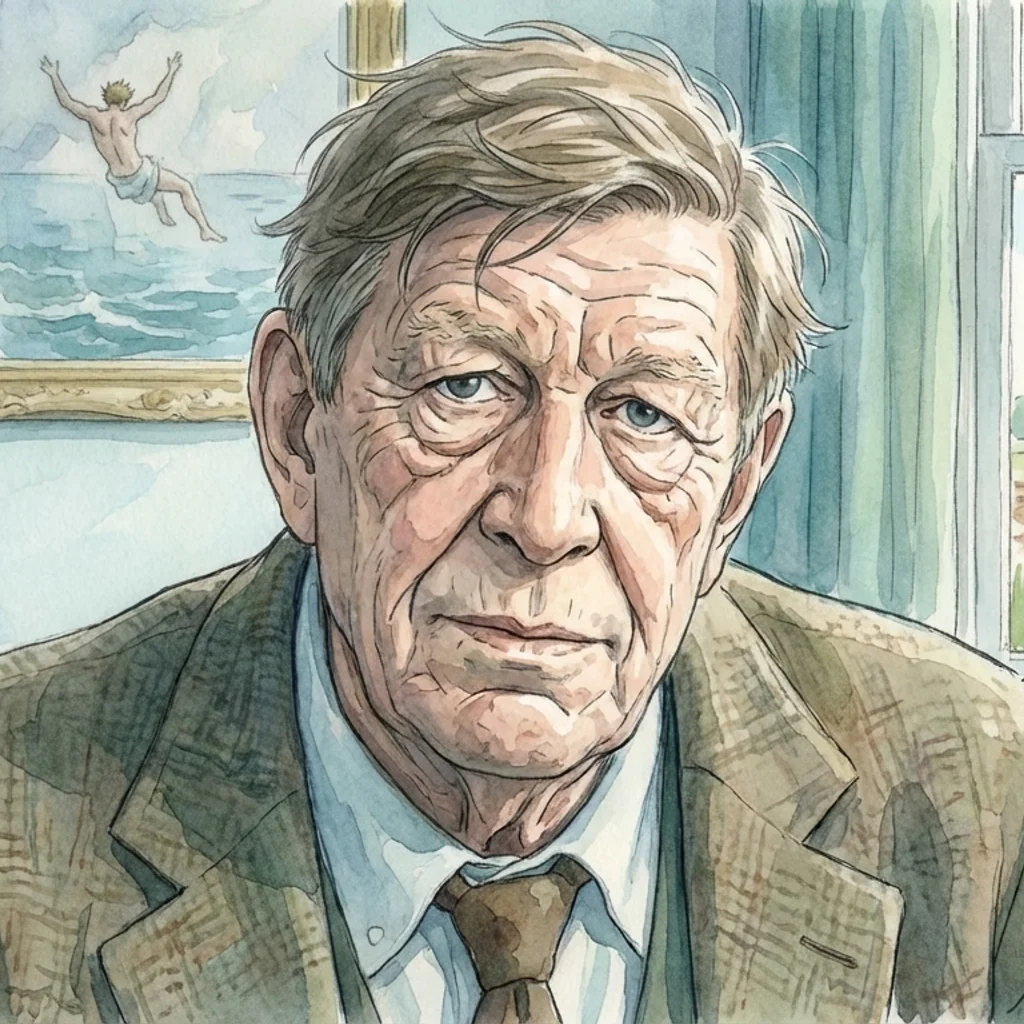
1938