Notable Works
- The Waste Land
- The Love Song of J. Alfred Prufrock
- Four Quartets
- The Hollow Men
- Ash Wednesday
- Murder in the Cathedral
Thomas Stearns Eliot was one of the twentieth century’s most influential poets and literary critics. His groundbreaking poem “The Waste Land” (1922) became a defining work of literary Modernism, fragmenting traditional poetic form to capture the disillusionment of the post-World War I era.
Early Life and Education
Born in St. Louis, Missouri, in 1888 to a prominent Boston Brahmin family, Eliot was raised in an atmosphere of high culture and moral earnestness. His grandfather had founded Washington University in St. Louis, and the family valued education and public service.
Eliot studied at Harvard University, where he encountered the poetry of the French Symbolists and the metaphysical poets—influences that would shape his distinctive voice. He pursued graduate work in philosophy at Harvard, the Sorbonne, and Oxford, immersing himself in Eastern philosophy, Sanskrit, and Western metaphysics.
Move to England
In 1914, Eliot traveled to England on a fellowship, intending to complete his doctorate. He would never return to live in America. In London, he met Ezra Pound, who became his most important literary mentor and advocate. Pound heavily edited “The Love Song of J. Alfred Prufrock” (written while Eliot was still at Harvard) and helped secure its publication in 1915. The poem’s interior monologue of a paralyzed, anxiety-ridden modern man announced a major new voice in poetry.
“The Waste Land”
Eliot’s masterpiece, “The Waste Land” (1922), emerged from a period of personal crisis. Working at Lloyd’s Bank and in an unhappy marriage, Eliot suffered a nervous breakdown. The poem he drafted during recovery was radically edited by Pound, who cut nearly half the original manuscript. The result—434 lines of fragmented scenes, multiple voices, and allusions spanning Western and Eastern literature—captured the spiritual barrenness of modern civilization.
The poem shocked readers with its difficulty and innovation:
- Fragmented structure: No single narrative or speaker
- Dense allusions: References to Shakespeare, Dante, Buddhist texts, music hall songs, and dozens of other sources
- Multiple languages: English, German, French, Italian, Sanskrit
- Mythic framework: Drawing on anthropology and comparative religion, particularly Jessie Weston’s From Ritual to Romance
Conversion and Later Work
In 1927, Eliot took British citizenship and was confirmed in the Church of England, famously describing himself as “classicist in literature, royalist in politics, and anglo-catholic in religion.” This conversion profoundly affected his later work, which increasingly explored Christian themes and traditional forms.
“Ash Wednesday” (1930) marked his first major poem as a Christian, exploring themes of spiritual struggle and renewal. His greatest achievement in this phase was “Four Quartets” (1943), four long meditative poems that explore time, consciousness, and spiritual illumination. Written during World War II, they combined philosophical depth with moving accessibility.
Drama and Criticism
Eliot also achieved success as a playwright, particularly with “Murder in the Cathedral” (1935), about Thomas Becket’s martyrdom, and “The Cocktail Party” (1949), which brought verse drama to the commercial stage.
As a critic, Eliot reshaped literary taste and canon formation. His essays championed the metaphysical poets (especially Donne), reconsidered the Jacobean dramatists, and introduced concepts like the “objective correlative” and the “dissociation of sensibility.” He argued that poetry should be impersonal, that the poet should focus on the work rather than expressing personal emotion.
Working Life
Throughout his career, Eliot worked in publishing, joining Faber and Faber in 1925, where he championed poets including W.H. Auden, Stephen Spender, and Ted Hughes. This editorial work gave him enormous influence over twentieth-century poetry.
Personal Life
Eliot’s first marriage to Vivienne Haigh-Wood was troubled; she suffered from mental illness, and they separated in 1933. In 1957, at age sixty-eight, Eliot married his secretary Valerie Fletcher, finding happiness in his final years.
Legacy and Honors
Eliot received the Nobel Prize in Literature in 1948 and the Order of Merit. His influence on poetry was immense—he made difficulty and allusion central to serious poetry, demonstrated how ancient and modern could coexist, and showed how tradition could be radically reinvented rather than merely preserved.
Influence on Modernism
Eliot’s work demonstrated that poetry could be:
- Intellectually demanding: Requiring knowledge of multiple traditions
- Formally innovative: Breaking with Victorian and Georgian conventions
- Culturally diagnostic: Capturing the fragmentation and anxiety of modernity
- Spiritually serious: Addressing ultimate questions without sentimentality
While his conservative later views on religion and culture became controversial, his poetic achievement remains central to understanding twentieth-century literature. He transformed what poetry could be and how it could engage with tradition, creating works that continue to challenge and reward readers.
Influenced By
- Dante Alighieri
- John Donne
- Charles Baudelaire
- Jules Laforgue
- Ezra Pound
Influenced
- Ezra Pound
- James Joyce
Poems by T.S. Eliot (2)
Browse with filters →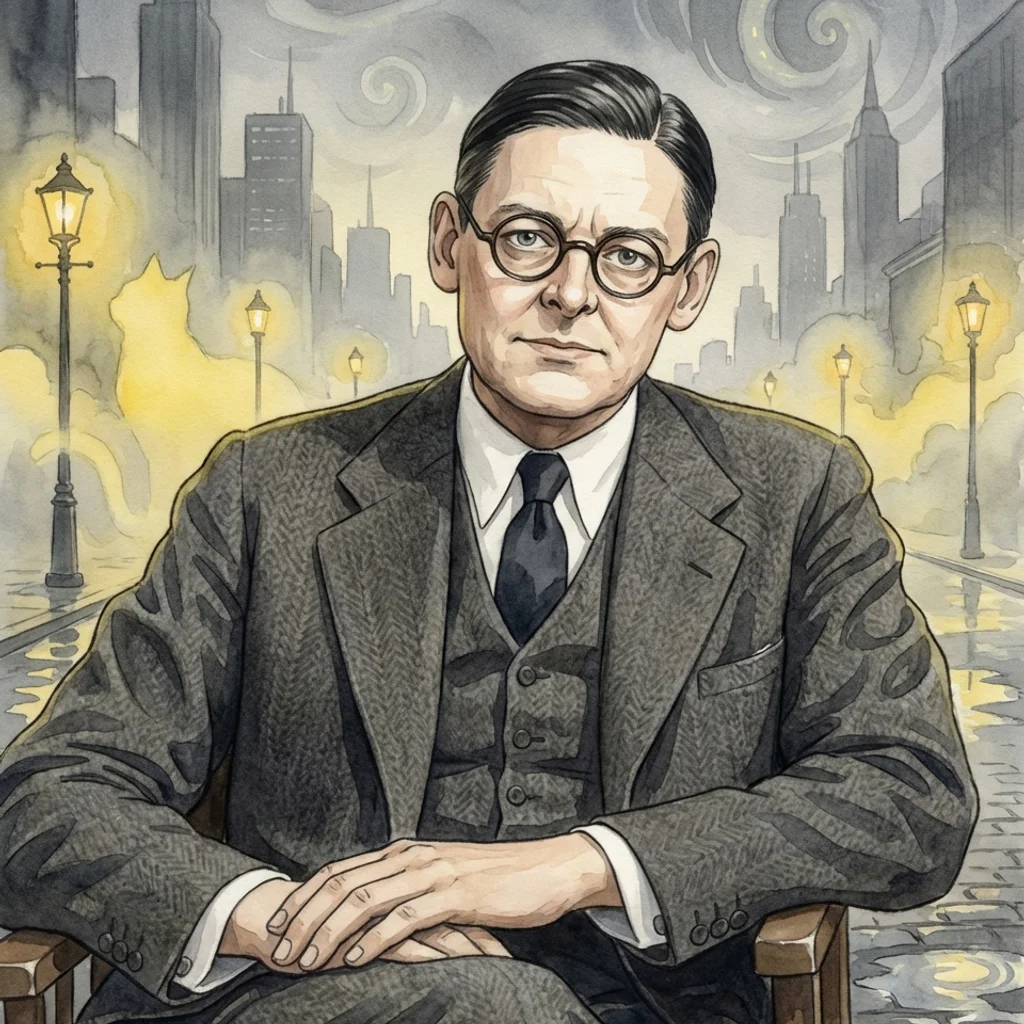
1911
1911