Notable Works
- The Darkling Thrush
- Neutral Tones
- The Convergence of the Twain
- Drummer Hodge
- During Wind and Rain
- Channel Firing
Thomas Hardy was one of the greatest English novelists of the Victorian era who, after abandoning fiction following hostile critical reception, reinvented himself as one of the finest poets of the early twentieth century. His poetry, like his novels, portrays a universe governed by impersonal forces indifferent to human suffering, yet his work is marked by deep compassion for human vulnerability and by precise observation of the natural world.
Early Life and Career as Novelist
Born in 1840 in a cottage in Higher Bockhampton, Dorset, Hardy grew up in the rural world he would immortalize in his fiction and poetry. His father was a stonemason and builder, and Hardy trained as an architect before turning to writing. This architectural training influenced his poetry’s careful construction and his attention to physical structures as expressions of time and change.
Hardy established his reputation with novels set in “Wessex,” his fictional recreation of southwest England. Works like Far from the Madding Crowd (1874), The Mayor of Casterbridge (1886), Tess of the d’Urbervilles (1891), and Jude the Obscure (1895) portrayed rural life with psychological depth and unflinching honesty about sex, class, and social hypocrisy.
Turn to Poetry
The savage critical and moral condemnation of Jude the Obscure—which dealt frankly with sexuality, marriage, and religious doubt—devastated Hardy. He essentially abandoned fiction and devoted the last thirty years of his life to poetry, which he had always considered his true calling. Between 1898 and his death in 1928, he published eight volumes of verse containing nearly a thousand poems, many of them masterpieces.
This late flowering was remarkable. While many writers decline in old age, Hardy’s poetic powers grew. His final volume, Winter Words, published posthumously, contains some of his finest work, written when he was in his eighties.
Poetic Vision
Hardy’s poetry is shaped by his philosophical pessimism. Influenced by Darwin, Schopenhauer, and Victorian science, he saw the universe as governed by blind chance or by an unconscious “Immanent Will” indifferent to human welfare. This worldview, which he called his “evolutionary meliorism,” pervades his verse.
Yet Hardy’s pessimism never became mere cynicism. His poems are marked by tenderness toward human suffering, by acute psychological observation, and by moments of unexpected beauty. He wrote with particular sympathy about animals, rural laborers, and the socially marginalized—those whom Victorian society rendered invisible.
Major Poems
“The Darkling Thrush,” written on December 31, 1900, as the nineteenth century ended, exemplifies Hardy’s characteristic movement from bleakness toward unexpected, if tentative, hope. The speaker encounters a winter landscape of utter desolation, “The Century’s corpse outleant,” when a thrush bursts into song. The bird’s caroling offers “Some blessed Hope, whereof he knew / And I was unaware,” though the poem carefully avoids endorsing this hope.
“The Convergence of the Twain” responds to the sinking of the Titanic in 1912. Rather than writing conventional elegy, Hardy portrays the iceberg and ship as destined lovers being prepared by the “Immanent Will” for their fatal “consummation.” The poem’s unusual form—eleven three-line stanzas with short first lines and long third lines—visually suggests both the ship’s shape and the inexorable movement toward catastrophe.
Poems of Memory and Loss
Hardy’s first wife, Emma Gifford Hardy, died in 1912 after years of marital estrangement. Her death released an extraordinary flood of elegiac poetry. The “Poems of 1912-13” sequence contains some of the most powerful love poetry in English, written by a man in his seventies revisiting the landscape of his courtship and confronting his failures as a husband.
“The Voice” imagines hearing Emma calling “with the original air-blue gown,” while “After a Journey” returns to the Cornish coast where they first met: “I see what you are doing: you are leading me on / To the spots we knew when we haunted here together.” These poems transform personal grief into universal meditations on memory, regret, and the impossibility of recovering the past.
Poetic Style
Hardy’s poetry is notable for:
- Metrical experimentation: He invented complex stanza forms and used intricate rhyme schemes
- Diction: He mixed archaic, dialect, and invented words with colloquial speech
- Irony: His poems often work through dramatic irony and unexpected reversals
- Specific detail: Like his novels, his poems ground abstract ideas in concrete particulars
- Dramatic voices: Many poems are spoken by characters or overhear conversations
His style was unfashionable in his own time and influenced by eighteenth-century hymn meters and ballads rather than by his modernist contemporaries. This apparent awkwardness was deliberate—Hardy valued the expression of complex thought over smooth musicality.
Influence
Hardy had little immediate influence; his style was too idiosyncratic to spawn imitators. However, his reputation grew steadily through the twentieth century. Poets including W.H. Auden, Philip Larkin, and Seamus Heaney acknowledged him as a crucial influence. His ability to combine philosophical depth with narrative power, his honest confrontation with loss and disappointment, and his refusal of easy consolation continue to speak to readers.
Legacy
Hardy was honored throughout his later life, receiving the Order of Merit in 1910. When he died in 1928, his heart was buried in Emma’s grave in Stinsford churchyard, while his ashes were interred in Westminster Abbey’s Poets’ Corner—a division that somehow suits a writer who always saw the world as split between ideal and real, hope and experience.
Hardy proved that poetry need not offer comfort to be valuable. His best poems acknowledge life’s cruelties while maintaining compassion and finding beauty in unexpected places. In an age of easy optimism, his honest pessimism and his determination to “look on tempests and not be shaken” remain powerfully relevant.
Influenced By
- William Wordsworth
- Percy Bysshe Shelley
- Charles Darwin
Poems by Thomas Hardy (1)
Browse with filters →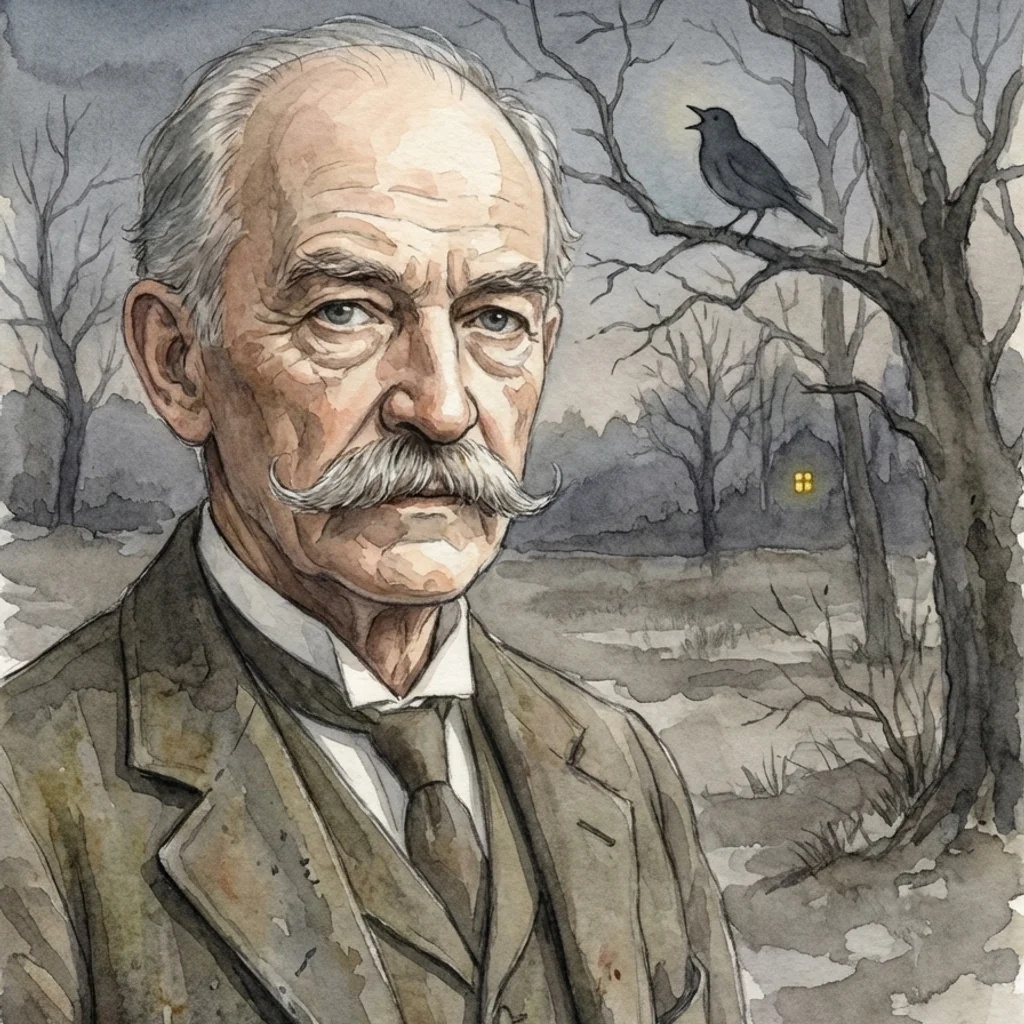
1900