Notable Works
- The Dream Songs
- Homage to Mistress Bradstreet
- 77 Dream Songs
- Berryman's Sonnets
John Berryman was an American poet whose innovative Dream Songs—a sequence of 385 poems—rank among the major achievements of twentieth-century American poetry. A central figure in the confessional poetry movement alongside Robert Lowell, Sylvia Plath, and Anne Sexton, Berryman created a unique poetic voice that combined formal innovation, linguistic playfulness, psychological depth, and unflinching self-examination. His life was marked by brilliance and suffering, alcoholism and academic success, culminating in his suicide at age fifty-seven.
Early Trauma
Born John Allyn Smith Jr. in McAlester, Oklahoma, in 1914, Berryman experienced the defining trauma of his life at age twelve when his father shot himself outside the family’s Tampa, Florida, home. The circumstances were suspicious—some suspected his mother’s lover may have been involved—and Berryman never resolved his feelings about his father’s death.
His mother remarried quickly, and John took his stepfather’s surname, Berryman. The family moved to New York, where Berryman attended South Kent School and then Columbia University. He was a brilliant student who studied with Mark Van Doren and began developing literary ambitions. He won a fellowship to study at Cambridge, where he absorbed Anglo-Catholic literary tradition and the influence of W.B. Yeats and W.H. Auden.
Early Career and Academic Life
Berryman taught at various universities—Wayne State, Harvard, Princeton—before settling at the University of Minnesota in 1955, where he remained until his death. He was an intense, demanding teacher who inspired many students while struggling with alcoholism and manic-depressive illness.
His early poetry, collected in volumes like The Dispossessed (1948), showed technical skill but followed conventional modernist models. Critics recognized talent but not yet distinctive voice. Berryman was acutely aware of his derivative early work and of the challenge of finding his own voice in the shadow of Eliot, Pound, and Yeats.
“Homage to Mistress Bradstreet”
Berryman’s breakthrough came with “Homage to Mistress Bradstreet” (1953), a long poem that imagines a conversation between the poet and Anne Bradstreet, America’s first published poet. The poem uses Berryman’s invented stanza form and creates a complex voice that blends Bradstreet’s seventeenth-century diction with modern psychological insight.
The poem addresses Bradstreet’s struggle to write in Puritan New England, her experiences of childbirth and loss, and her resistance to repressive religious and social structures. The poet’s voice interrupts, creating dialogue and blurring temporal boundaries. The poem demonstrated Berryman’s ability to inhabit another consciousness while maintaining contemporary relevance.
Edmund Wilson called it “the most distinguished long poem by an American since The Waste Land,” and it established Berryman as a major poet. More importantly, working on “Homage” taught Berryman he could create new forms and voices rather than imitating established models.
The Dream Songs
Berryman’s masterwork, The Dream Songs, consists of 385 eighteen-line poems written over more than a decade. The first installment, 77 Dream Songs (1964), won the Pulitzer Prize. The complete sequence appeared as The Dream Songs in 1969.
The songs create a fictional character—Henry, “a human American man”—while drawing heavily on Berryman’s own life. Henry speaks sometimes in first person, sometimes in third (“Henry sats in de plane”), and is addressed by a friend or alter ego who speaks in minstrel dialect and calls him “Mr. Bones.” This multiplicity of voices—some critics identify up to four separate speakers—creates a fragmented self-portrait.
The songs address Berryman’s father’s suicide (repeatedly), his alcoholism, his academic life, his love affairs, his friends’ deaths (including Delmore Schwartz and Randall Jarrell), racial guilt, religious doubt, and the difficulty of living. They combine high literary diction with slang, formal structure with linguistic violence, despair with black comedy.
Form and Style
Each Dream Song follows a consistent but flexible form: eighteen lines divided into three six-line stanzas with variable rhyme schemes and meters. This structure provides coherence while allowing for tonal and rhythmic variety. Berryman’s syntax is deliberately fractured, omitting words, inverting order, and using dialect to create a distinctive, immediately recognizable voice.
Sample lines from Dream Song 14: “Life, friends, is boring. We must not say so… / The sky flashes, the great sea yearns, / we ourselves flash and yearn, / and moreover my mother told me as a boy / (repeatingly) ‘Ever to confess you’re bored / means you have no // Inner Resources.’”
The poetry combines sophistication and childishness, learning and vulgarity, self-pity and self-mockery. The speaker is simultaneously victim and clown, sufferer and performer. This complexity prevents the poetry from becoming merely self-indulgent confession.
Confessional Poetry
Berryman was grouped with Robert Lowell, Sylvia Plath, and Anne Sexton as a “confessional poet”—a label he rejected. While his poetry drew on personal experience, he insisted he was creating art, not therapy. The Dream Songs’ use of a fictional character (however autobiographical) and their formal intricacy distinguish them from simply versified autobiography.
Yet the poems are undeniably personal, addressing Berryman’s demons with brutal honesty. They record a mind in extremis, attempting to survive through poetry. Dream Song 29 declares “There sat down, once, a thing on Henry’s heart / só heavy, if he had a hundred years / & more, & weeping, sleepless, in all them time / Henry could not make good.” The “thing” is clearly his father’s suicide.
Alcoholism and Mental Illness
Berryman’s alcoholism worsened throughout his career, leading to hospitalizations, blackouts, and deteriorating health. The Dream Songs chronicle this decline while also being enabled by it—some songs were composed while drunk or in hospitals. The relationship between Berryman’s suffering and his art remains troubling: did the poetry require the suffering, or did the suffering destroy the poet who might have written even greater work?
His late poem “Certainty Before Lunch” acknowledges addiction’s grip: “Ninety percent of the mass of the Universe / (90%!) may be gone in the form of / neutrinos, rotten / neutrons. / My methods are obscure / but their object is not.” The percentages and statistics mask desperate need.
Religious Struggle
Berryman’s later work shows increasing engagement with religious questions. Never conventionally religious, he wrestled with faith, particularly after a born-again experience during one hospitalization. Love & Fame (1970) traces his early life and ends with a sequence of direct prayers to God—surprising in a poet known for irony and multiple voices.
“Eleven Addresses to the Lord” shows Berryman seeking salvation while doubting his worthiness: “I heard upon waking / ‘You’re not alone’ / in a real voice, / coming from nowhere.” These poems abandon the Dream Songs’ elaborate apparatus for direct address, though skepticism persists.
Suicide
On January 7, 1972, Berryman jumped from the Washington Avenue Bridge in Minneapolis to his death. He had attempted suicide before and had been hospitalized multiple times. He left behind an unfinished novel, Recovery, about an alcoholic professor in treatment—thinly veiled autobiography.
His death at fifty-seven ended one of the most intense and sustained poetic projects in American literature. Whether he had exhausted his subject (himself) or was finding new directions remains unknown. His late uncollected poems show both continued brilliance and deepening despair.
Legacy and Influence
Berryman’s influence has been complex. The Dream Songs demonstrated that long poetic sequences could be built from discrete lyrics rather than narrative, that formal innovation and personal content could combine, and that American poetry could create voices as distinctive as those in fiction.
His example influenced later poets interested in sequence, persona, and formal innovation. However, the confessional mode’s excesses—self-indulgence, exhibitionism—also provoked reaction. Later poets have admired Berryman’s technical achievement while questioning whether the cult of personality serves poetry.
Critical Reception
77 Dream Songs won the Pulitzer Prize in 1965. His Toy, His Dream, His Rest (1968), completing the sequence, won the National Book Award. Critical reception has remained divided. Some consider the Dream Songs one of the century’s major poetic achievements; others find them solipsistic and verbose.
The poems’ difficulty—syntactic fragmentation, tonal shifts, private references—can alienate readers. Yet they reward persistent attention, revealing depth, humor, and craft beneath apparent chaos. The question of whether they represent confessional poetry’s triumph or its dead end continues to be debated.
Achievement
Berryman’s achievement lies in creating a distinctive voice and form capable of capturing modern consciousness’s fragmentation while maintaining aesthetic integrity. The Dream Songs map a mind’s interior landscape with unprecedented detail and honesty. They demonstrate that long poetic sequences need not be narrative or epic to achieve coherence and power.
At his best, Berryman combines technical virtuosity with emotional authenticity, learning with vulnerability, and despair with defiant comedy. His work expanded American poetry’s range, showing that serious poetry could incorporate slang, dialect, humor, and self-mockery without losing seriousness.
Whether Berryman’s life exemplifies the romantic myth of the doomed poet or serves as a cautionary tale about creativity and self-destruction remains contested. What is certain is that he created a body of work unique in American poetry—anguished, brilliant, difficult, and unmistakably his own. The Dream Songs remain essential reading for anyone interested in how poetry can represent consciousness, how form can contain chaos, and how language can enact rather than merely describe the struggle to survive.
Influenced By
- W.B. Yeats
- T.S. Eliot
- Anne Bradstreet
- Robert Lowell
Poems by John Berryman (1)
Browse with filters →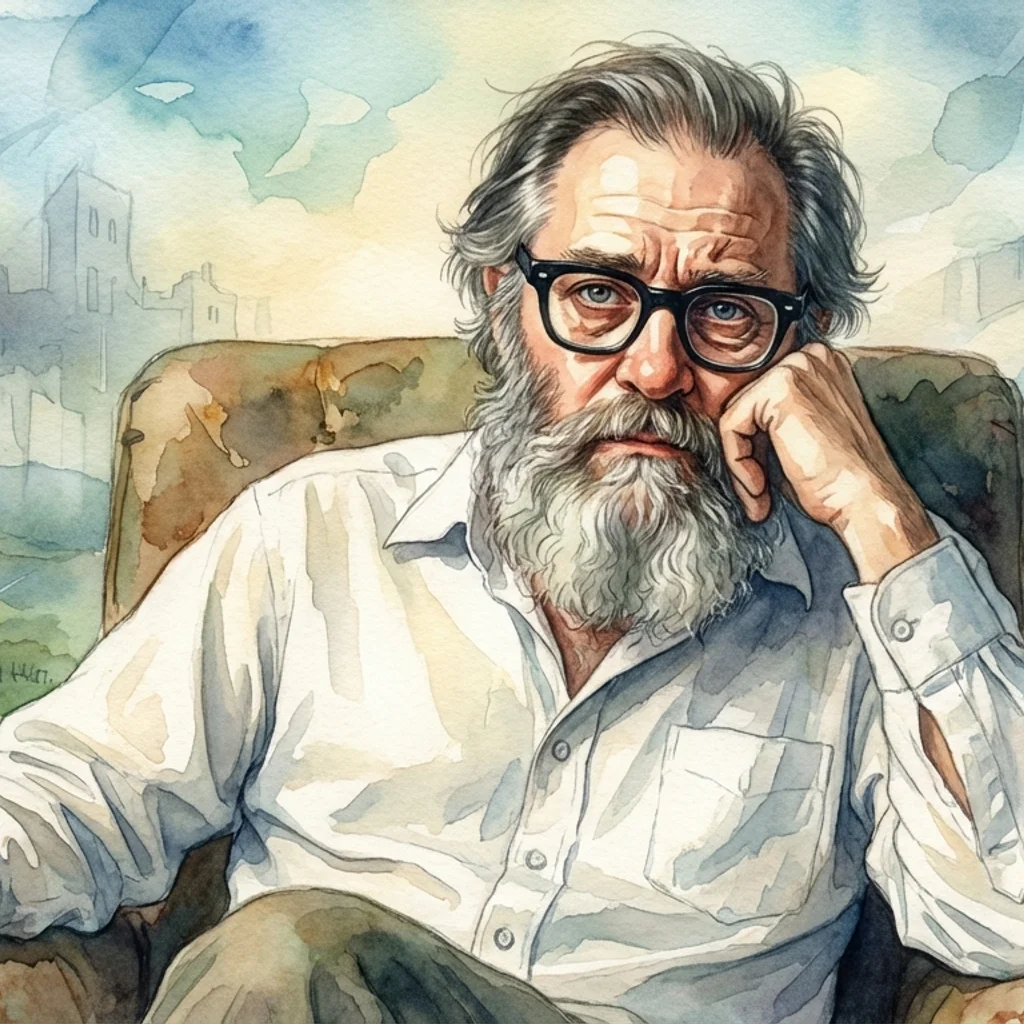
1964