Henry Wadsworth Longfellow
1807–1882
- Born:
- Portland, Maine, USA
- Died:
- Cambridge, Massachusetts, USA
Notable Works
- Paul Revere's Ride
- The Song of Hiawatha
- Evangeline
- The Wreck of the Hesperus
- A Psalm of Life
- The Village Blacksmith
Henry Wadsworth Longfellow was the most popular American poet of the nineteenth century, creating verse narratives and lyric poems that became part of American cultural memory. His work includes some of the most memorized and quoted poems in American literature, from “Paul Revere’s Ride” to “The Song of Hiawatha.” While his reputation declined in the twentieth century as critics favored difficulty over accessibility, Longfellow’s achievement in creating a genuinely American poetry that reached vast audiences while maintaining artistic integrity remains significant.
Privileged Beginnings
Born in Portland, Maine, in 1807 into a prominent family, Longfellow enjoyed educational and social advantages rare among American poets. He attended Bowdoin College, where he was classmates with Nathaniel Hawthorne, graduating in 1825. His facility with languages was evident early—he published his first poem at thirteen and was fluent in multiple European languages by young adulthood.
After graduation, Bowdoin offered him a professorship in modern languages on the condition that he study in Europe. Longfellow spent 1826-29 traveling through France, Spain, Italy, and Germany, immersing himself in European literature and culture. This experience shaped his poetic ambition: he would bring European literary sophistication to American subjects, creating a distinctly American literature equal to European models.
Academic Career
Longfellow taught at Bowdoin from 1829 to 1835, then moved to Harvard, where he occupied the Smith Professorship of Modern Languages and Belles Lettres for eighteen years. His teaching focused on European literature, particularly German and Scandinavian works, which would influence his own poetry.
Teaching provided financial security but left limited time for creative work. Longfellow was an effective, popular teacher who introduced American students to European literature, though his real passion was his own writing. He published translations, textbooks, and novels alongside his poetry.
Personal Tragedy
Longfellow’s life was marked by devastating losses. His first wife, Mary Potter, died in 1835 during their European travels, possibly from complications of miscarriage. He grieved deeply, channeling his sorrow into his work.
In 1843, he married Frances “Fanny” Appleton, with whom he had six children and found great happiness. They lived in Craigie House, a gracious Cambridge mansion that became a center of literary and social life. However, in 1861, Fanny’s dress caught fire while she was sealing envelopes with hot wax. She died the next day. Longfellow tried to save her and was badly burned; he grew a beard to hide his facial scars.
Longfellow never recovered from Fanny’s death. He channeled his grief into translating Dante’s Divine Comedy, using the demanding work as therapy. His later poetry often deals with loss and mortality, though always in controlled, public forms rather than confessional outpouring.
Narrative Poems and American Mythology
Longfellow’s greatest popular successes were long narrative poems that helped create American mythology. Evangeline (1847), written in dactylic hexameter (the meter of Homer and Virgil), tells of Acadian lovers separated during the French and Indian War. The poem’s opening—“This is the forest primeval”—became immediately famous.
The Song of Hiawatha (1855) attempts to capture Native American legends in trochaic tetrameter (based on the Finnish epic Kalevala). The poem tells of the Ojibwe hero Hiawatha with lines like “By the shores of Gitche Gumee, / By the shining Big-Sea-Water.” While the poem’s treatment of Native American culture is problematic by modern standards—it romanticizes and distorts Indigenous traditions—it represented a serious attempt to incorporate Native American material into American literature.
The Courtship of Miles Standish (1858) creates a New England founding myth in heroic couplets. These poems gave Americans their own epic narratives, comparable to European national epics. They were enormously popular, selling hundreds of thousands of copies and being memorized by generations of schoolchildren.
“Paul Revere’s Ride”
Perhaps Longfellow’s most enduringly famous poem, “Paul Revere’s Ride” (1860), takes considerable liberties with historical fact to create a stirring patriotic narrative. Written as the Civil War loomed, the poem calls Americans to vigilance: “A cry of defiance and not of fear, / A voice in the darkness, a knock at the door, / And a word that shall echo forevermore!”
The poem’s galloping rhythm mimics a horse’s hooves, while its narrative clarity and dramatic structure make it ideal for memorization and recitation. Generations of American children learned the opening: “Listen, my children, and you shall hear / Of the midnight ride of Paul Revere.”
Shorter Lyrics
Longfellow’s shorter poems were equally popular. “A Psalm of Life” (1838) offers Victorian optimism and moral earnestness: “Life is real! Life is earnest! / And the grave is not its goal.” The poem’s message—act, don’t just reflect; make your mark on the world—resonated with American ambition and work ethic.
“The Village Blacksmith” celebrates honest labor and the dignity of manual work. “The Wreck of the Hesperus” tells a tragic tale of a sea captain who foolishly takes his daughter on a doomed voyage. These poems combined moral instruction with vivid storytelling.
Translation and European Influence
Longfellow was America’s most accomplished translator of his era. His translation of Dante’s Divine Comedy introduced many Americans to the work and remains readable. He translated poems from German, French, Spanish, Italian, and Scandinavian languages, helping create American cosmopolitanism.
His anthology Poems of Places (31 volumes, 1876-79) collected poetry about locations worldwide, demonstrating his scholarly ambition and his desire to connect American readers to world literature.
Poetic Technique
Longfellow was a master of traditional prosody. He could write in virtually any meter—dactylic hexameter, trochaic tetrameter, ballad meter, blank verse—with ease. This technical facility made his poems musical and memorable but also led later critics to accuse him of superficiality.
His diction tends toward the elevated and poetic rather than colloquial. Unlike Whitman, who revolutionized American poetry by using everyday speech, Longfellow maintained genteel poetic conventions. This made his work accessible to Victorian readers but seemed old-fashioned to modernists.
Popularity and Influence
During his lifetime, Longfellow was phenomenally successful. His books sold hundreds of thousands of copies—extraordinary numbers for poetry. He was the first American poet to have a bust placed in Westminster Abbey’s Poets’ Corner, alongside Shakespeare, Milton, and other British literary giants.
His seventy-fifth birthday in 1882 was celebrated nationally, with schools holding special exercises in his honor. When he died shortly thereafter, the nation mourned. He had become a cultural institution, America’s official poet.
Decline and Reassessment
Longfellow’s reputation collapsed in the early twentieth century. Modernist poets and critics rejected everything he represented: conventional forms, moral didacticism, genteel diction, optimism, accessibility. Ezra Pound dismissed him contemptuously; New Critics ignored him.
For decades, Longfellow was considered at best a children’s poet, at worst a symbol of everything wrong with Victorian poetry. His poems were removed from college curricula and relegated to elementary school readers.
Recent decades have seen modest reassessment. Scholars recognize his importance in creating American literary culture, his technical skill, and his success in reaching wide audiences. His work is studied as cultural history and as an example of how poetry functions in public life.
Legacy
Longfellow demonstrated that American poets could create works rivaling European literature while addressing distinctly American subjects. He showed that poetry could be both artistically accomplished and widely popular. His narrative poems helped create American mythology and gave Americans shared cultural references.
His limitations are real: his poetry rarely achieves the psychological depth of Dickinson, the democratic expansiveness of Whitman, or the philosophical complexity of Emerson. His treatment of non-white people reflects his era’s prejudices. His optimism and moral certainty can seem naive.
Yet at his best, Longfellow created poems of genuine beauty and power. His technical mastery ensured his verse remained memorable. His narrative gift made his poems storytelling vehicles that enriched American culture. His determination to create a democratic poetry that spoke to ordinary people, while sometimes leading to sentimentality, also represented an important American ideal.
Whether Longfellow was a great poet or merely a skilled craftsman who served his culture’s needs remains debated. What is indisputable is that he shaped how Americans understood poetry and created works that became part of the nation’s collective memory—an achievement few poets of any era can claim.
Influenced By
- Johann Wolfgang von Goethe
- Nordic sagas
- European Romanticism
Poems by Henry Wadsworth Longfellow (1)
Browse with filters →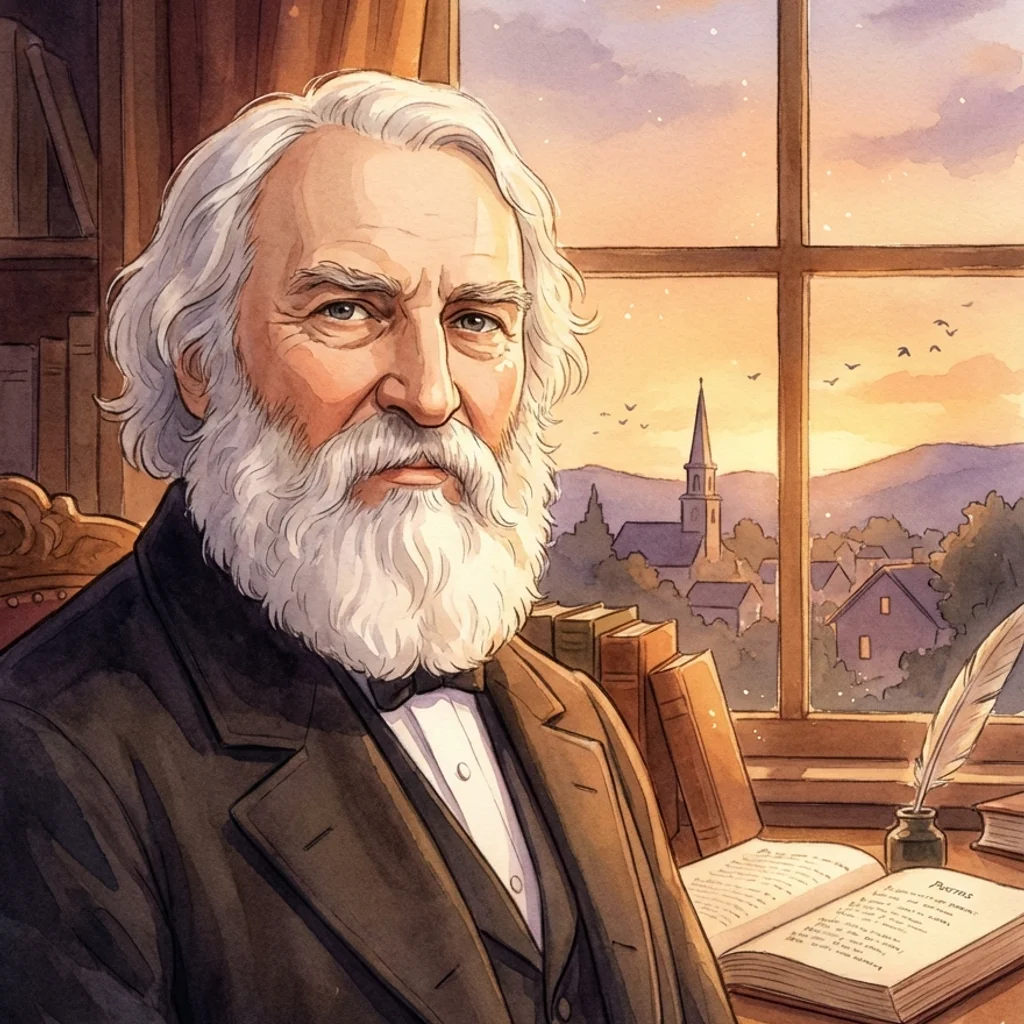
1844