Notable Works
- Chicago
- Fog
- Grass
- Cool Tombs
- The People, Yes
Carl Sandburg was an American poet, biographer, and folklorist who gave voice to industrial America and working-class life in free verse poems that combined Whitmanesque expansiveness with modernist compression. Best known for his celebration of Chicago and his multi-volume biography of Abraham Lincoln, Sandburg created a distinctly American poetry rooted in the language of ordinary people, the rhythms of labor, and the landscapes of the Midwest. His work represents an important strand of American modernism focused on democratic inclusiveness rather than elite difficulty.
Working-Class Origins
Born in Galesburg, Illinois, in 1878, Sandburg was the son of Swedish immigrants. His father was a railroad blacksmith’s helper who never learned to read or write English. Sandburg left school at thirteen to work a succession of manual jobs—milkman, porter, dishwasher, farm laborer, brickyard worker. These experiences gave him intimate knowledge of working-class life that would permeate his poetry.
At twenty, Sandburg rode the rails as a hobo, an experience that exposed him to America’s vastness and diversity. He served briefly in the Spanish-American War, then used his veteran’s benefits to attend Lombard College in Galesburg, though he left without graduating. These years introduced him to literature and gave him confidence as a writer, though his real education came from work and travel.
Early Career and Political Engagement
Sandburg worked as a journalist and advertising writer while developing his poetry. He was active in socialist politics, working as an organizer and writing for socialist newspapers. He met Lilian Steichen, sister of photographer Edward Steichen, whom he married in 1908. Lilian was a remarkable woman—a socialist activist and scholar—who supported Sandburg’s literary work while pursuing her own interests.
His early poetry was conventional and derivative. The breakthrough came when he began writing in free verse about subjects drawn from his own experience—industrial labor, immigrant life, cities, prairies. This shift from literary convention to authentic voice transformed his work.
“Chicago” and Early Success
The poem “Chicago,” published in Poetry magazine in 1914, announced Sandburg’s arrival as a major voice. The poem’s opening—“Hog Butcher for the World, / Tool Maker, Stacker of Wheat, / Player with Railroads and the Nation’s Freight Handler; / Stormy, husky, brawling, / City of the Big Shoulders”—celebrates the city’s industrial power and working-class energy.
The poem acknowledges Chicago’s violence and poverty—“they tell me you are wicked,” “they tell me you are crooked”—before insisting on the city’s vitality: “Come and show me another city with lifted head singing so proud to be alive.” The poem’s cataloging technique and free verse rhythms echo Whitman, but Sandburg’s diction is more colloquial and his focus more specifically industrial.
“Chicago” won the Levinson Prize from Poetry and established Sandburg’s reputation. His first major collection, Chicago Poems (1916), expanded this success, bringing working-class subjects and American vernacular into serious poetry.
Imagist Tendencies
While Sandburg wrote long, Whitmanesque catalogs, he could also write with imagist compression. “Fog” demonstrates this gift:
“The fog comes on little cat feet.
It sits looking over harbor and city on silent haunches and then moves on.”
The poem’s simple metaphor and clear images exemplify imagist principles while maintaining accessibility. Unlike some imagist work, which could seem coldly aesthetic, Sandburg’s brief poems retain human warmth.
“Grass,” written in response to World War I, is similarly compressed: “Pile the bodies high at Austerlitz and Waterloo. / Shovel them under and let me work— / I am the grass; I cover all.” The grass speaks with chilling indifference to human suffering, a powerful antiwar statement in few words.
The People
Sandburg’s populist politics informed his poetic project. He believed poetry should be accessible to ordinary people, not just educated elites. His work celebrates workers, immigrants, and common folk rather than aristocrats or intellectuals. This democratic impulse connects him to Whitman and to American democratic traditions.
The People, Yes (1936), a long poem written during the Depression, collects American folk sayings, tall tales, and vernacular speech to create a portrait of American character. The poem affirms faith in ordinary people’s wisdom and resilience. While sometimes dismissed as sentimental or propagandistic, the work represents Sandburg’s most ambitious attempt to create a genuinely democratic poetry.
Lincoln Biography
Sandburg spent decades researching and writing his six-volume biography of Abraham Lincoln, published between 1926 and 1939. Abraham Lincoln: The Prairie Years (2 volumes) and Abraham Lincoln: The War Years (4 volumes) won the Pulitzer Prize for History in 1940 and remain influential, though modern historians criticize their occasionally loose relationship with documentary evidence.
The biography reflects Sandburg’s view of Lincoln as a man of the people whose greatness emerged from common origins. Like Sandburg’s poetry, the biography celebrates democratic values and vernacular culture.
Folk Songs and American Culture
Sandburg was a dedicated collector and performer of American folk songs. His anthology The American Songbag (1927) preserved hundreds of songs from diverse traditions. He performed these songs at readings, accompanying himself on guitar, making his poetry events multimedia experiences that anticipated later developments in performance poetry.
This engagement with folk culture wasn’t separate from his poetry but integral to it. Sandburg believed poetry should connect to oral traditions and popular culture rather than remaining purely literary.
Later Work and Recognition
Sandburg’s later poetry collections—Smoke and Steel (1920), Slabs of the Sunburnt West (1922), Good Morning, America (1928)—continued his earlier methods with diminishing critical success. By mid-century, his populist free verse seemed old-fashioned compared to the difficulty and compression of high modernism.
However, he remained popular with general readers and received official honors, including the Pulitzer Prize for Poetry in 1951 for Complete Poems. He spoke at the Joint Session of Congress commemorating Lincoln’s birthday in 1959, testimony to his status as a national bard.
Style and Technique
Sandburg’s poetry is characterized by:
- Free verse: Whitmanesque long lines and catalogs
- Vernacular language: Speech of workers and ordinary Americans
- Industrial imagery: Factories, railroads, steel mills
- Regional focus: Midwest landscapes and cities
- Repetition: Use of refrains and repeated phrases
- Oral qualities: Poems written to be heard as well as read
His style valued accessibility and emotional directness over difficulty and irony. This made him popular with general audiences but suspect to academic critics who valued modernist complexity.
Critical Reputation
Sandburg’s reputation has fluctuated significantly. During his lifetime, he was enormously popular, performing to large audiences and selling many books. However, New Critics and academic modernists dismissed his work as formless, sentimental, and simplistic.
Recent decades have seen more balanced assessment. Critics recognize his importance in bringing working-class life and American vernacular into serious poetry. His influence on later poets interested in accessibility and performance is acknowledged. However, even admirers concede that his work is uneven, with brilliant compressed lyrics alongside diffuse longer works.
Legacy
Sandburg demonstrated that modernist free verse could serve populist rather than elite purposes. He showed that poetry could address contemporary industrial life without abandoning beauty or emotional power. His best short poems—“Chicago,” “Fog,” “Grass,” “Cool Tombs”—remain widely anthologized and read.
His vision of America—democratic, working-class, ethnically diverse—offered an alternative to the wasteland visions of Eliot and Pound. While less influential on academic poetry, his work shaped popular understanding of what American poetry could be.
Sandburg proved that a poet could be both serious artist and public figure, maintaining artistic integrity while reaching broad audiences. Whether this combination represents a triumph or a compromise remains debated, but Sandburg’s achievement in creating a genuinely American voice in poetry—one rooted in work, speech, and democratic values—ensures his continuing significance.
Influenced By
- Walt Whitman
- American folk songs
- Industrial America
Poems by Carl Sandburg (1)
Browse with filters →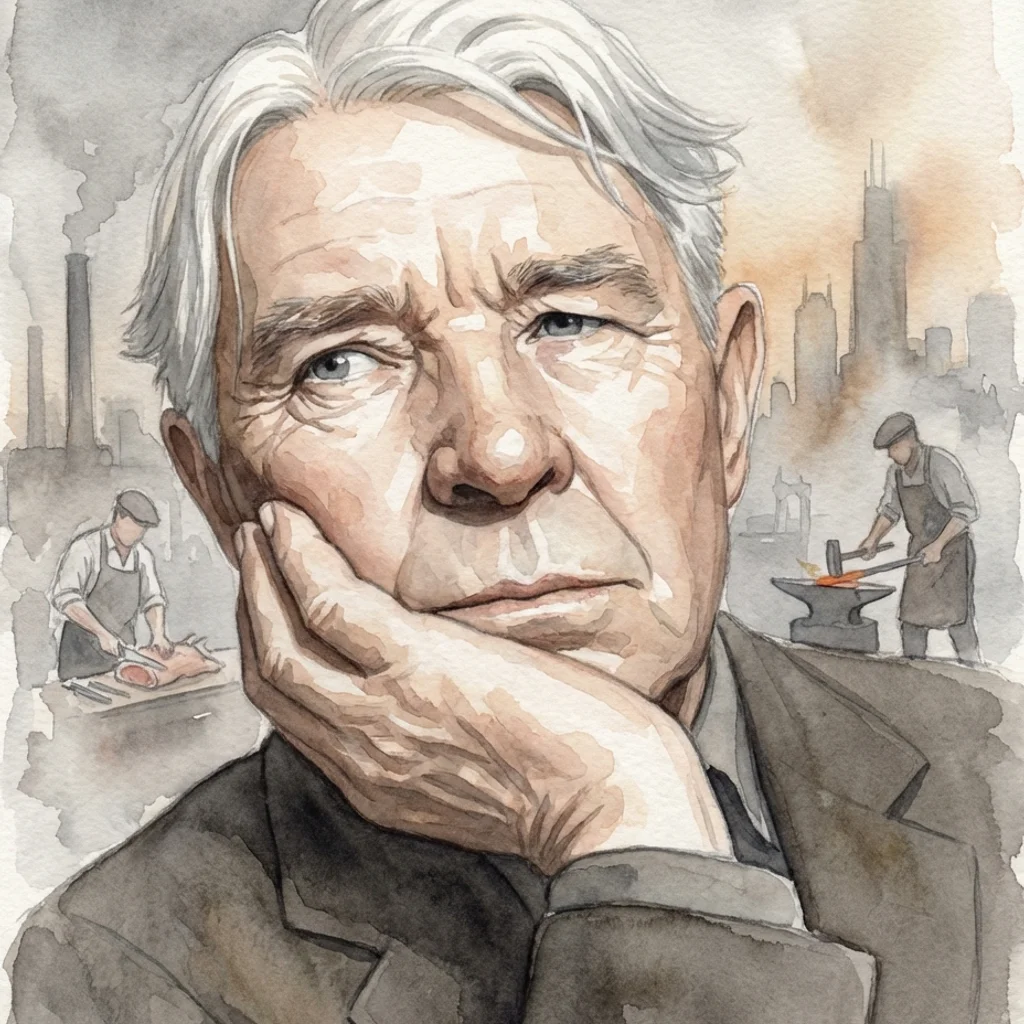
1914