Notable Works
- Leaves of Grass
- Song of Myself
- O Captain! My Captain!
- When Lilacs Last in the Dooryard Bloom'd
Walt Whitman is one of America’s most influential poets, often called the father of free verse. Born on Long Island in 1819, Whitman grew up in Brooklyn during a time of rapid social and industrial change in America.
Early Life and Career
Whitman left school at age eleven to help support his family, working as an office boy, printer’s apprentice, and teacher. He later became a journalist and editor for various newspapers in New York. These experiences gave him intimate knowledge of American life in all its diversity—an understanding that would profoundly shape his poetry.
Leaves of Grass
In 1855, Whitman self-published Leaves of Grass, a revolutionary collection of poems that broke from conventional poetic forms. The work celebrated democracy, nature, love, and the human body with unprecedented frankness. The first edition contained only twelve poems, but Whitman would revise and expand the collection throughout his life, eventually publishing nine editions. The final “deathbed edition” of 1891-92 contained nearly 400 poems.
Revolutionary Style
Whitman’s poetry was revolutionary in multiple ways:
- Free verse: He abandoned traditional meter and rhyme schemes, creating a new kind of American poetry
- Cataloging: His poems often contain long lists celebrating America’s diversity
- Democratic vision: He embraced all aspects of American life and all kinds of people
- Sensuality: He wrote openly about the body and physical experience
- Transcendental influence: Like Emerson, he saw divinity in nature and the common person
Civil War Years
During the Civil War, Whitman served as a volunteer nurse in Washington, D.C., caring for wounded soldiers from both Union and Confederate armies. The experience deeply affected him, inspiring some of his most moving poetry, including “When Lilacs Last in the Dooryard Bloom’d,” his elegy for President Lincoln.
Later Years
After suffering a stroke in 1873, Whitman moved to Camden, New Jersey, where he spent his final years. Despite declining health, he continued to write and revise his work. He died in 1892, having established himself as America’s most distinctive poetic voice.
Legacy
Whitman’s influence on American poetry cannot be overstated. He opened new possibilities for poetic form and subject matter, inspiring generations of poets from Hart Crane to Allen Ginsberg. His celebration of democracy, individualism, and the American experience helped define a distinctly American literary tradition. His bold experimentation with form and his embrace of everyday life and common speech created a template for modern poetry that remains vital today.
Influenced By
- Ralph Waldo Emerson
- Italian Opera
Influenced
- Ralph Waldo Emerson
- Homer
- The Bible
Poems by Walt Whitman (2)
Browse with filters →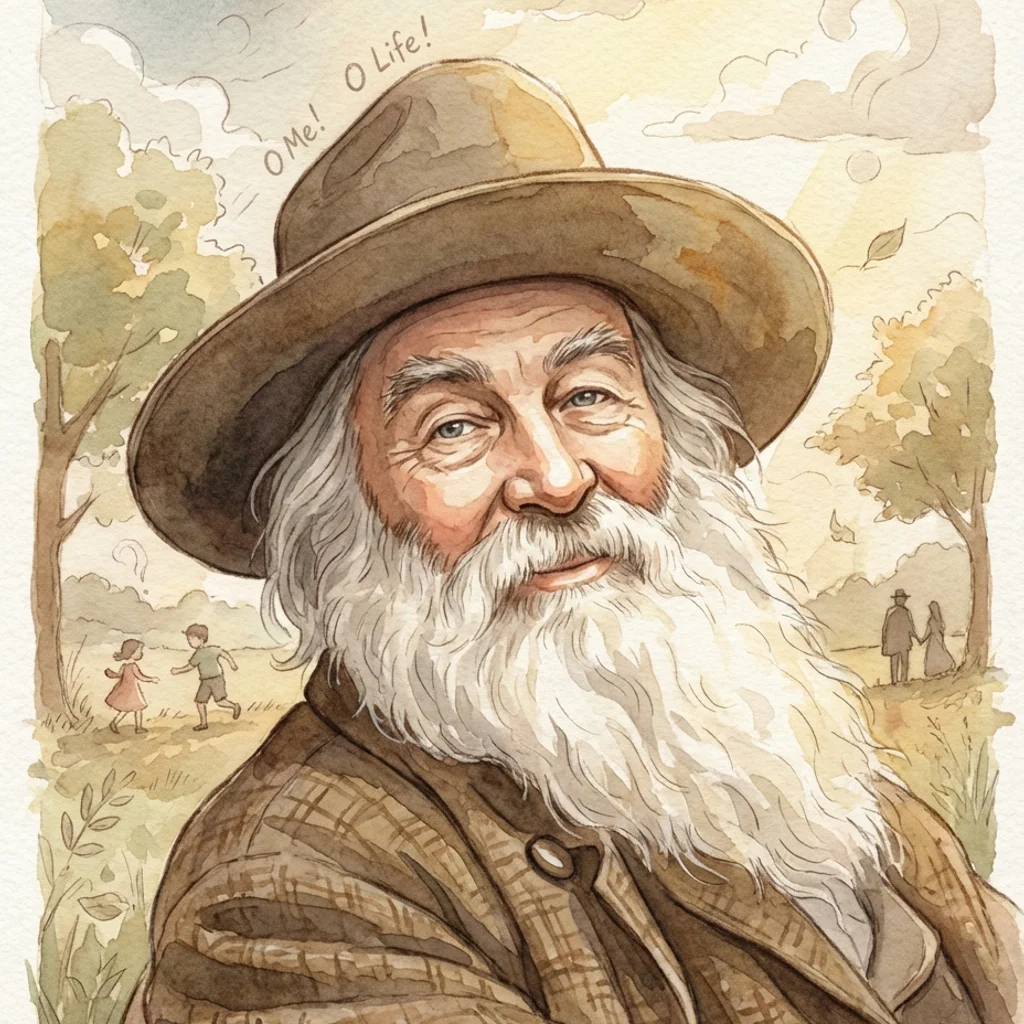
1892
1855