Notable Works
- The Tyger
- The Lamb
- London
- The Chimney Sweeper
- Songs of Innocence and of Experience
- The Marriage of Heaven and Hell
- Jerusalem
William Blake was an English poet, painter, and printmaker whose visionary work anticipated Romanticism and prefigured modernist innovations. Largely unrecognized during his lifetime, Blake is now considered one of the most original and important figures in the history of both poetry and visual art. His illuminated books, which combine text and image in unprecedented ways, create a unified artistic vision exploring the relationship between innocence and experience, imagination and reason, freedom and oppression.
Early Life and Artistic Training
Born in London in 1757, Blake grew up in modest circumstances, the son of a hosier. He showed artistic talent early and was apprenticed at age fourteen to an engraver, James Basire. This training in engraving would prove crucial—it gave Blake the technical skills to produce his illuminated books and influenced his linear, precise visual style.
Blake received little formal education but read widely, particularly in the Bible, Milton, and radical political and religious works. From childhood, he experienced visions: he saw angels in a tree, the prophet Ezekiel in a field. While some have speculated about mental illness, Blake’s visions appear to have been controlled imaginative experiences that he distinguished from ordinary perception.
Marriage and Partnership
In 1782, Blake married Catherine Boucher, the daughter of a market gardener. Catherine was illiterate when they married, but Blake taught her to read and write, and she became his crucial collaborator, helping print and color his illuminated books. Their partnership lasted until Blake’s death, though they had no children. By all accounts, their marriage was based on mutual devotion and shared creative work.
Illuminated Printing
Blake developed a revolutionary method of relief etching that allowed him to integrate text and image on the same copper plate. He would write his text in mirror writing with a resistant substance, draw his designs around and through it, then etch the plate in acid. Each page could then be printed and hand-colored. This laborious process meant that Blake’s books existed in very small numbers, contributing to his obscurity during his lifetime.
The illuminated books are among the most beautiful objects in English literature. Text and image comment on each other in complex ways—sometimes reinforcing, sometimes contradicting, always enriching meaning. This multimedia approach makes Blake a precursor to modern experimental art.
Songs of Innocence and of Experience
Blake’s Songs of Innocence (1789) and Songs of Experience (1794), eventually published together as Songs of Innocence and of Experience: Shewing the Two Contrary States of the Human Soul, represent his most accessible and enduringly popular work. The poems are deceptively simple, using plain language and ballad meters to explore profound questions about childhood, authority, suffering, and spiritual vision.
“The Lamb” from Innocence and “The Tyger” from Experience are perhaps Blake’s most famous poems, often read as companion pieces. “The Lamb” presents creation as gentle and childlike: “Little Lamb who made thee / Dost thou know who made thee?” “The Tyger” confronts the terrifying aspects of creation: “Tyger Tyger, burning bright, / In the forests of the night; / What immortal hand or eye, / Could frame thy fearful symmetry?”
The poems don’t present innocence as simply good and experience as bad. Rather, they explore how these states complement and complicate each other. Innocence can be naive and vulnerable; experience can be wise but also corrupted and despairing.
Social Criticism
Many of Blake’s poems offer searing social criticism, particularly of child labor and the Church’s complicity in oppression. “The Chimney Sweeper” appears in both Innocence and Experience with radically different perspectives. The Innocence version shows a child comforted by dreams of heaven; the Experience version reveals this comfort as a tool of oppression: “They clothed me in the clothes of death, / And taught me to sing the notes of woe.”
“London” is Blake’s most powerful indictment of urban industrial society. The speaker wanders through chartered streets hearing “marks of weakness, marks of woe” in every face, culminating in the image of the “youthful Harlot’s curse” that “blasts the new-born Infant’s tear” and “blights with plagues the Marriage hearse.” The poem’s compression and symbolic density make every word resonant.
Prophetic Books
Blake’s longer prophetic books—including The Marriage of Heaven and Hell, The Book of Urizen, Milton, and Jerusalem—are more difficult and have been less widely read. These works develop Blake’s personal mythology, featuring characters like Los (imagination), Urizen (reason), and Orc (revolution). They explore themes of spiritual freedom, the imagination’s power, and the necessity of contraries.
The Marriage of Heaven and Hell is perhaps the most accessible of these works, containing Blake’s most quoted lines: “The road of excess leads to the palace of wisdom,” “If the doors of perception were cleansed every thing would appear to man as it is, Infinite,” and “Prisons are built with stones of Law, Brothels with bricks of Religion.”
Blake’s Philosophy
Blake developed a complex personal philosophy that rejected Enlightenment rationalism and orthodox Christianity while drawing on mystical and radical religious traditions. Key elements include:
- Imagination as primary: For Blake, imagination is not fancy but the highest human faculty
- Contraries: Progress requires the dynamic tension between opposites
- Rejection of dualism: He opposed the separation of body and soul, matter and spirit
- Criticism of institutionalized religion: He distinguished the institutional church from genuine spirituality
- Political radicalism: He supported the French and American Revolutions and opposed slavery and oppression
Later Life and Legacy
Blake spent most of his life in poverty, earning a precarious living as an engraver while pursuing his own creative work. He received some patronage, particularly from Thomas Butts, who commissioned many paintings and supported Blake for years. However, public exhibitions of his work were failures, and his 1809 exhibition drew a devastating review calling him “an unfortunate lunatic.”
Despite poverty and neglect, Blake continued working until his death in 1827. He died singing, according to witnesses, and was buried in an unmarked grave in Bunhill Fields. Catherine Blake survived him by four years, preserving and selling his work.
Blake’s influence grew slowly after his death. The Pre-Raphaelites admired him, and William Butler Yeats edited his work in the 1890s. The twentieth century saw his full recognition as a major poet and artist. His influence extends far beyond poetry into music, visual art, and popular culture.
Enduring Relevance
Blake’s work speaks powerfully to contemporary concerns. His critique of rationalism, materialism, and institutional oppression remains relevant. His celebration of imagination, his insistence that everything that lives is holy, his defense of the body and of pleasure, and his complex exploration of innocence and experience continue to inspire artists, poets, and thinkers.
His technical innovations in combining word and image prefigured modern multimedia art. His visionary approach to poetry expanded what poems could do and be. More than two centuries after his death, Blake remains a vital, challenging, endlessly rewarding artist whose work rewards lifelong engagement.
Influenced By
- John Milton
- Emanuel Swedenborg
- The Bible
Poems by William Blake (1)
Browse with filters →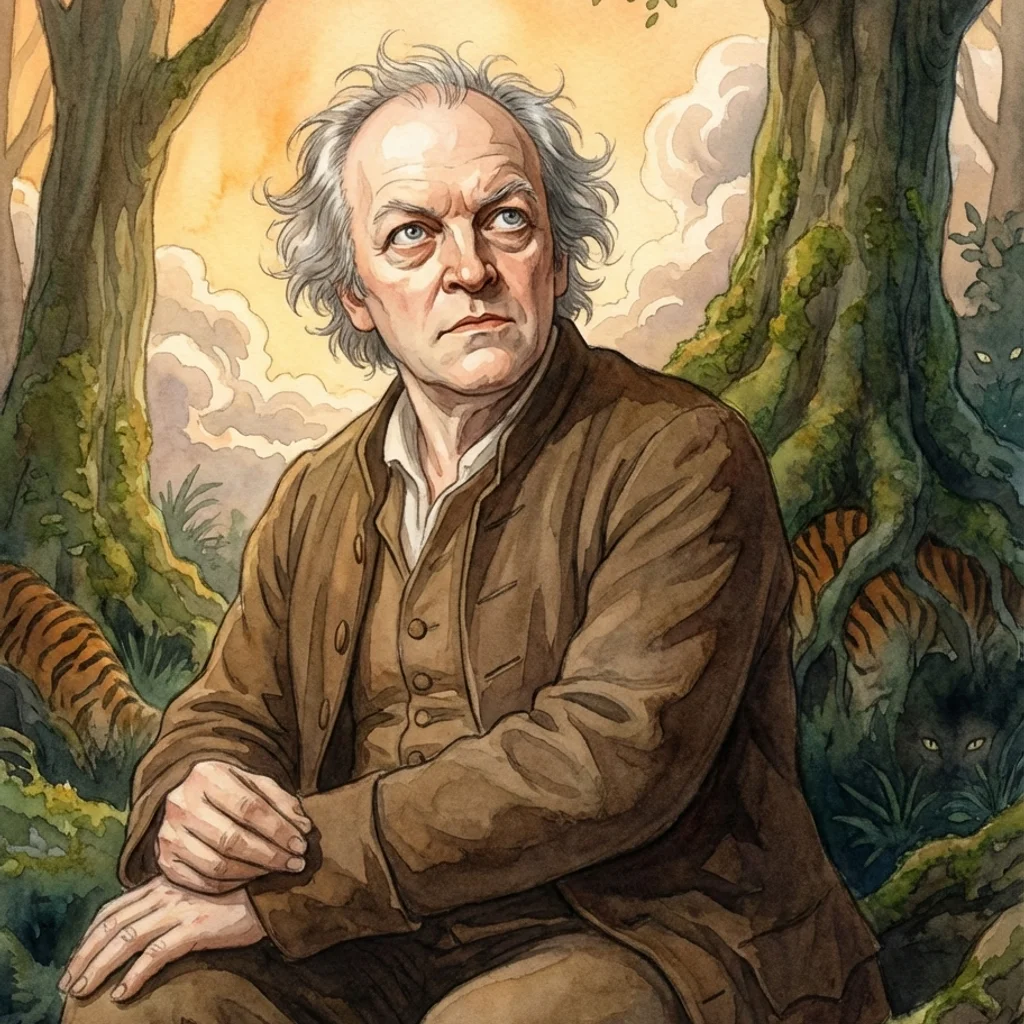
1794