Notable Works
- If—
- The White Man's Burden
- Gunga Din
- Mandalay
- Recessional
- The Gods of the Copybook Headings
Rudyard Kipling was the first English-language writer to win the Nobel Prize in Literature (1907) and remains one of the most widely read poets in English, though also one of the most controversial. His work captures the British Empire at its height, celebrating soldiers, engineers, and administrators while revealing the empire’s underlying anxieties. His poetry combines sophisticated technique with music-hall rhythms, creating verse that is simultaneously popular and complex.
Early Life in India and England
Born in Bombay in 1865, Kipling spent his early childhood in India, cared for by Portuguese Catholic ayahs and speaking Hindustani as readily as English. This bicultural upbringing would profoundly shape his writing, giving him an insider’s knowledge of Indian life rare among British writers of his era.
At age five, following Victorian custom, Kipling was sent to England to be educated. He and his sister were boarded with a family in Southsea who treated them cruelly—an experience Kipling later described as the “House of Desolation.” This traumatic period left him with permanent psychological scars but also with the sympathy for suffering children that appears throughout his work.
Return to India and Early Success
At seventeen, Kipling returned to India to work as a journalist, first in Lahore, then in Allahabad. These seven years (1882-89) were extraordinarily productive. He wrote the stories collected in Plain Tales from the Hills and the poems in Departmental Ditties, establishing the subjects and style that would define his career: the British Raj, military life, the collision of cultures, and the gap between official pieties and actual behavior.
His work was immediately popular. When he arrived in London in 1889, at age twenty-three, he was already famous. The poetry collection Barrack-Room Ballads (1892), which included “Gunga Din,” “Mandalay,” and “Tommy,” made him a sensation. These poems gave voice to common soldiers in their own dialect, treating them as worthy subjects for serious art—a radical move in Victorian literature.
Poetic Innovation
Kipling’s poetry revolutionized English verse by incorporating working-class speech, music-hall rhythms, and non-literary sources. “Gunga Din” tells the story of an Indian water-carrier’s heroism through the voice of a British soldier whose racism gives way to respect: “You’re a better man than I am, Gunga Din!” The poem simultaneously reinforces and subverts imperial hierarchies.
“Mandalay” evokes nostalgia for Burma through a cockney soldier’s voice: “Ship me somewheres east of Suez, where the best is like the worst, / Where there aren’t no Ten Commandments an’ a man can raise a thirst.” The poem’s musicality and exotic imagery made it instantly popular, and its opening line, “On the road to Mandalay,” entered the language.
His technical range was extraordinary. He could write ballads, hymns, mock-epics, dialect poems, and verse in classical meters with equal facility. “Recessional” (1897), written for Queen Victoria’s Diamond Jubilee, warns against imperial hubris in the measured language of a hymn: “Far-called, our navies melt away; / On dune and headland sinks the fire: / Lo, all our pomp of yesterday / Is one with Nineveh and Tyre!”
“If—” and Popularity
“If—” (1910), perhaps the most widely known poem in English, exemplifies both Kipling’s strengths and the reasons for later critical dismissal of his work. The poem offers advice to his son on how to become a man, counseling stoicism, self-reliance, and emotional control. Lines like “If you can keep your head when all about you / Are losing theirs” and “If you can meet with Triumph and Disaster / And treat those two impostors just the same” have become proverbial.
The poem’s philosophy—Victorian masculinity, the stiff upper lip, empire-building virtues—has made it both beloved and derided. Yet the poem is more complex than it appears, its conditional structure implying that such perfection is unattainable even as it sets forth the ideal.
Imperial Ideology and Controversy
Kipling’s relationship to empire is complex and troubling. “The White Man’s Burden” (1899), written to encourage American colonization of the Philippines, has become synonymous with imperialist racism. The poem portrays colonialism as a thankless duty undertaken for the benefit of “sullen peoples, / Half-devil and half-child.” While Kipling likely saw this as a serious moral argument, from any modern perspective the poem is indefensibly racist.
Yet Kipling’s imperialism was never simple jingoism. He understood empire’s costs and frequently criticized imperial incompetence and hypocrisy. “Tommy” protests the British public’s contempt for soldiers: “O it’s Tommy this, an’ Tommy that, an’ ‘Tommy, go away’; / But it’s ‘Thank you, Mister Atkins’, when the band begins to play.” His sympathy consistently lay with those who did empire’s work rather than with those who profited from it.
Personal Tragedy
The Great War devastated Kipling personally and artistically. His only son John was killed at the Battle of Loos in 1915, age eighteen. Kipling, who had used his influence to get John a commission despite the boy’s poor eyesight, was consumed by guilt. His later poetry, including the stark epitaphs collected in The Years Between (1919), confronts grief and questions of meaning in a post-war world.
“My Boy Jack” and the “Epitaphs of the War” show a poet stripped of earlier certainties, facing irreparable loss. These poems are among his finest, their tight control barely containing overwhelming emotion.
Later Work
Kipling’s later poetry often explored themes of technological change, political decline, and the erosion of traditional values. “The Gods of the Copybook Headings” (1919) warns that ignoring fundamental truths leads to disaster. His late stories and poems show increasing darkness and technical sophistication, though they never regained his earlier popularity.
Legacy and Reassessment
Kipling’s reputation declined sharply after his death in 1936 and reached its nadir in the 1960s and 70s, when his imperialism made him deeply unfashionable. George Orwell’s 1942 essay acknowledged Kipling’s talent while condemning his politics, a pattern that has continued.
Recent decades have seen more nuanced reassessments. Critics recognize his technical brilliance, his insight into power and violence, and the complexity hidden beneath his seemingly straightforward verses. His influence on poets from T.S. Eliot to Seamus Heaney is undeniable.
Kipling remains inescapably problematic—a great poet whose politics and racial attitudes are often repugnant. Yet his best work transcends its historical moment, exploring timeless questions of duty, loss, craft, and the relationship between individual and community. Reading Kipling requires critical engagement with both his artistry and his ideology, but such engagement remains worthwhile.
Influenced By
- Robert Browning
- Algernon Charles Swinburne
- American tall tales and folk ballads
Poems by Rudyard Kipling (1)
Browse with filters →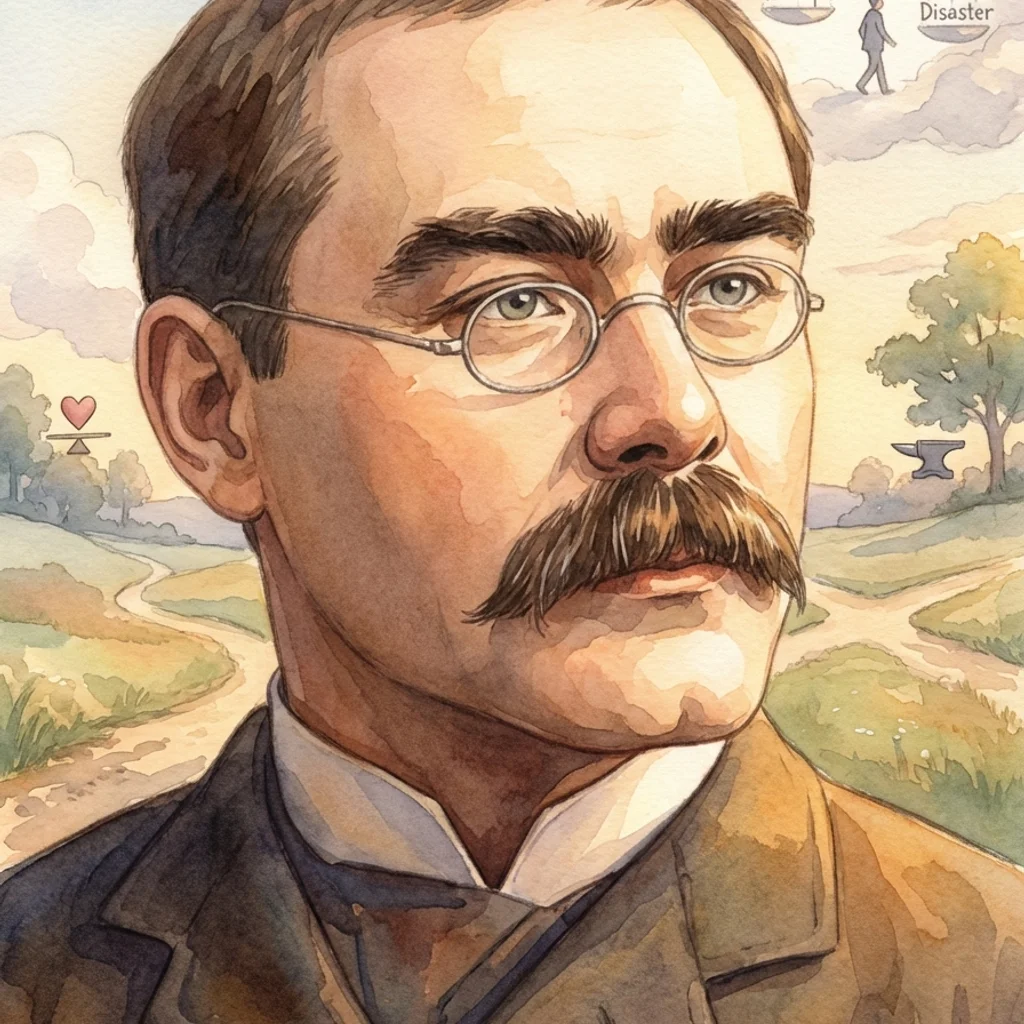
1895