Notable Works
- Ithaka
- Waiting for the Barbarians
- The City
- The God Abandons Antony
- Trojans
Constantine P. Cavafy, known as C.P. Cavafy, was a Greek poet who lived most of his life in Alexandria, Egypt, where he worked as a civil servant while creating some of the most distinctive poetry of the twentieth century. Writing in Greek but publishing very little during his lifetime, Cavafy developed a unique voice that blended historical and mythological subjects with personal, often homoerotic, themes. His work has had an enormous influence on later poets despite his relatively small output of about 155 finished poems.
Life in Alexandria
Born in 1863 to Greek parents in Alexandria, Cavafy belonged to the Greek diaspora community that had flourished in Egypt for centuries. His family was prosperous until his father’s death in 1870 plunged them into financial difficulty. The family moved to England for several years, where Cavafy received part of his education, before returning to Alexandria in 1877.
Cavafy spent most of his adult life working as a clerk in the Irrigation Service of the Egyptian Ministry of Public Works, a bureaucratic job that provided financial stability but little fulfillment. He lived modestly in an apartment above a brothel, famously remarking that his location was convenient: “Where could I live better? Below, the brothel caters to the flesh. And there is the church which forgives sin. And there is the hospital where we die.”
Poetic Development
Cavafy was a perfectionist who wrote slowly and published sparingly. Rather than releasing books, he distributed his poems in privately printed broadsheets to friends and admirers. This method gave him complete control over his work but also limited his readership during his lifetime. His first collection was not published until after his death.
His poetry is characterized by a distinctive tone—ironic, melancholic, sensuous, and historically informed. He wrote about three main subjects: Hellenistic history, especially the period after Alexander the Great; philosophical reflections on fate, desire, and memory; and personal poems about erotic encounters, usually between men.
Historical Poems
Many of Cavafy’s most celebrated poems reimagine moments from ancient history with psychological subtlety and modern sensibility. “Waiting for the Barbarians” depicts a city whose citizens await an expected barbarian invasion, only to be left in confusion when the barbarians don’t arrive: “Now what’s going to happen to us without barbarians? / Those people were a kind of solution.” The poem operates as both historical recreation and modern political allegory.
“The God Abandons Antony” portrays Mark Antony’s final night before defeat, when he hears invisible music signaling that Dionysus, his patron god, is leaving him. Rather than lamenting this abandonment, the poem advises dignity in loss: “Above all don’t fool yourself, don’t say / it was a dream, your ears deceived you: / don’t degrade yourself with empty hopes like these.”
Personal and Erotic Poems
Cavafy’s poems about desire and memory are remarkable for their time in their frank treatment of homosexual experience. These poems typically look back on past encounters with a mixture of pleasure and regret, understanding that memory both preserves and transforms experience. They speak in a quiet, conversational tone about moments of connection in shops, cafes, and rooms.
His treatment of these subjects was groundbreaking. While he published his historical poems more readily, he was cautious about distributing the more explicitly personal work, understanding the social constraints of his era. Yet these poems are central to his achievement, bringing the same psychological insight to personal experience that he brought to historical subjects.
“Ithaka”
His most famous poem, “Ithaka,” uses the journey of Odysseus as a metaphor for life itself. The poem advises the reader to hope for a long journey, to enjoy the sensual pleasures along the way, and to understand that the destination matters less than the experiences gained: “Ithaka gave you the marvelous journey. / Without her you wouldn’t have set out. / She has nothing left to give you now.”
The poem embodies Cavafy’s philosophy: value the process, not just the goal; embrace experience even when it leads to disappointment; understand that meaning emerges from the journey itself.
Poetic Style
Cavafy wrote in a deliberately flat, prosaic style that avoided poetic ornament. His poems use simple language, often incorporating mundane details—street names, dates, commercial transactions—that ground even his historical subjects in specific reality. This anti-rhetorical approach was revolutionary, anticipating later developments in twentieth-century poetry.
He wrote in demotic Greek rather than the formal katharevousa, choosing the language of everyday speech over literary convention. This choice aligned with his democratic subject matter and his resistance to grandiose posturing.
Recognition and Influence
Cavafy’s reputation grew slowly but steadily. E.M. Forster, who met him during World War I, helped introduce his work to English readers. W.H. Auden championed him, and translators including Edmund Keeley and Philip Sherrard made his work widely available in English.
Cavafy died in 1933 on his seventieth birthday, from cancer of the larynx. In his final years, unable to speak, he communicated by writing notes—a cruel irony for a poet who had always preferred the written to the spoken word.
Legacy
Cavafy’s influence on modern poetry has been profound. His ability to make ancient history speak to contemporary concerns, his frank treatment of homosexual desire, his ironic tone, and his deliberately prosaic style have all been widely imitated. Poets as diverse as Auden, Brodsky, and Merrill have acknowledged their debt to him. He demonstrated that poetry could be simultaneously personal and historical, sensuous and philosophical, accessible and profound—a combination that continues to inspire poets today.
Influenced By
- Ancient Greek literature
- Oscar Wilde
- Homer
Poems by C.P. Cavafy (1)
Browse with filters →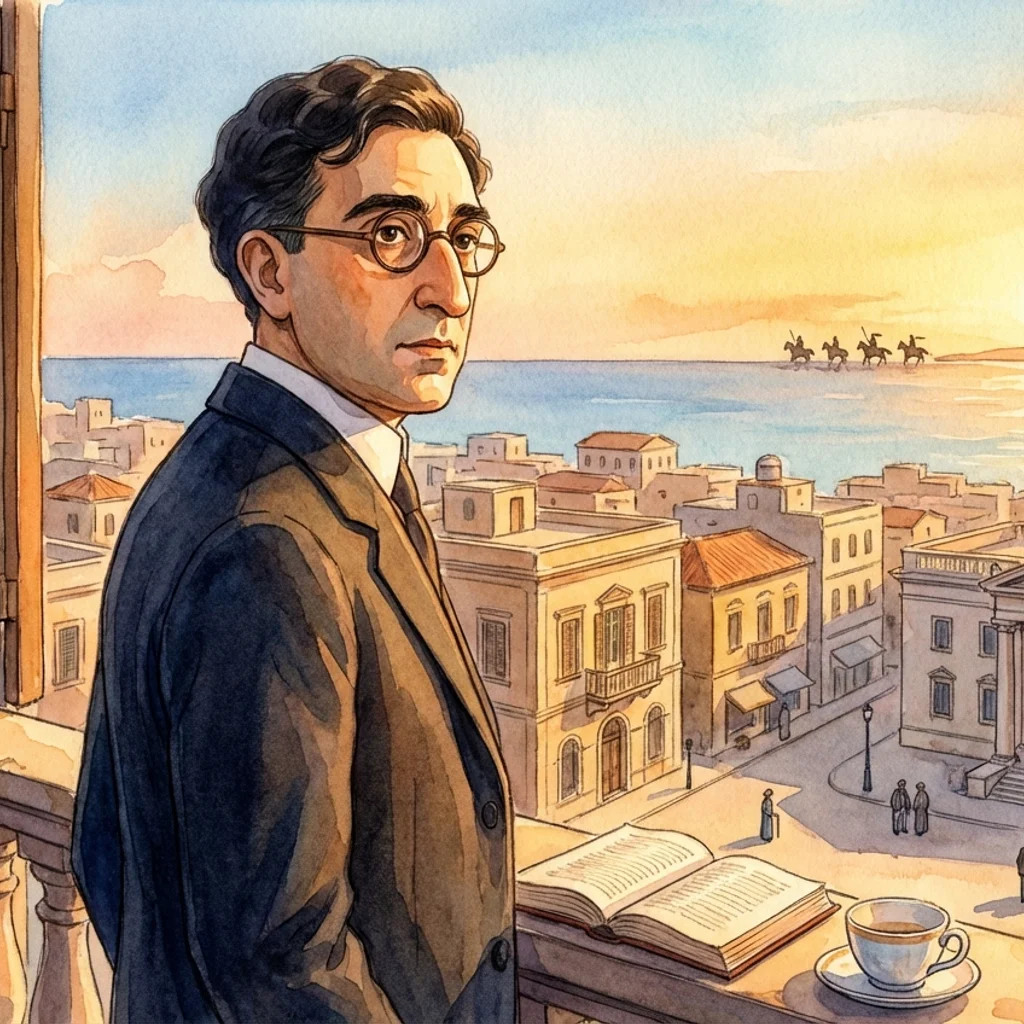
1898